


 English
 Deutsch

Content
- 1 Moisture Content: The First Number to Verify
- 2 Density and Hardness: What Compression Actually Does
- 3 Dimensional Stability: The Board's Real Outdoor Test
- 4 Surface Finish, Anti-Slip Profile, and UV Behavior
- 5 Resin Type and Bonding: The Hidden Chemical Standard
- 6 Certifications: Useful Only If You Read Them Correctly
- 7 A Field Checklist for Buyers
A landscaping contractor in the Netherlands once accepted a 780 square meter delivery of strand woven bamboo decking without reviewing the test reports. The boards arrived at 12.6 percent average moisture content. Four months later, the entire west-facing edge of the deck was cupped, and two boards had split beside the screw heads. The supplier's defense was that the flooring had "passed factory standards," yet neither side had actually defined those standards.
Quality standards for strand woven bamboo flooring are measurable numbers: moisture content between 6 and 8 percent, density near 1,100 kg/m³, Janka hardness above 3,000 lbf, thickness swelling below 8 percent after 24 hours of water immersion, and a phenol-formaldehyde or PMDI bonding system for outdoor exposure. Every one of these values can be verified before a container leaves the factory. This article explains what the numbers mean, why they matter outdoors, and how to check them when you buy.
Moisture Content: The First Number to Verify
Bamboo is hygroscopic, constantly exchanging moisture with the air. Strand woven bamboo flooring should leave the factory at 6 to 8 percent moisture content, roughly the equilibrium point for a ventilated interior or a covered outdoor deck in a temperate climate.
Inconsistent moisture content is the real danger. A board at 12 percent will shrink as it dries and pull the surface finish apart; a board at 4 percent will absorb moisture quickly and may expand along the width joints. When boards with different moisture contents sit side by side on the same joists, they move at different rates, and that movement shows up as cupping and hairline cracks.
What to check before ordering:
- Ask for the average moisture content measured at the end of the production line, not the value from the specification sheet.
- Use a pin-type moisture meter on at least 5 percent of the batch, spread over different pallets.
- At delivery, the reading should be no more than two percentage points above the factory value; a larger jump means moisture ingress during transport.
Poor moisture control usually becomes visible in the second year, as gapped joints, raised edges, and mold in the grooves. A deck protected from standing water and allowed to dry keeps its moisture content in a safe range for decades, following the routine laid out in our guide to maintaining outdoor bamboo decking for ten years.
Density and Hardness: What Compression Actually Does
Strand woven bamboo is made by shredding bamboo culms, saturating the strands with resin, and compressing them into dense boards. Finished density is the clearest evidence that the compression worked correctly. Real strand woven bamboo reaches 1,100 to 1,200 kg/m³; below 1,000 kg/m³, the strand structure contains micro-voids that become moisture paths and soft spots outdoors.
The Janka test, which measures resistance to indentation, is the most quoted number in bamboo marketing. Commercial strand woven bamboo rates above 3,000 lbf, two to three times red oak. But Janka does not predict screw withdrawal, bending strength, or splitting at the fastener line. For boards screwed to joists at 300 to 400 mm spacing, those properties matter just as much as hardness. The real-world consequences are discussed in our article on strand woven bamboo hardness and its real-world durability limits.
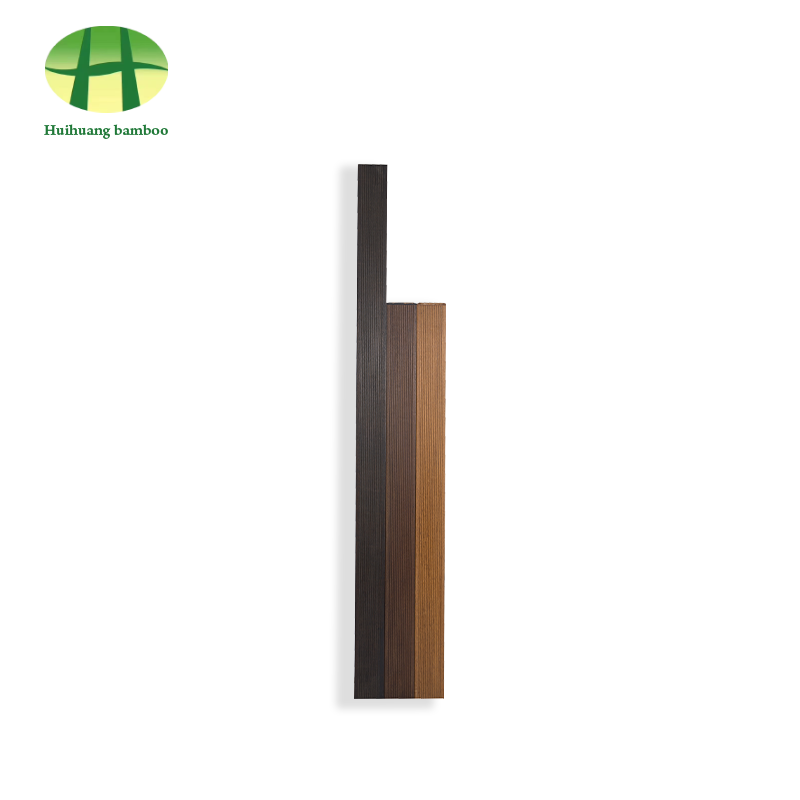
Density can also be checked locally: dry a 20 cm by 20 cm sample and divide its weight by its measured volume. It takes about an hour. When a supplier cannot document density and hardness on the actual batch, that is a reason to hesitate. For projects that need uniform board-to-board dimensions across a large terrace, choose a standard profile whose thickness and width are pressed and calibrated in the same process. Our standard-size glossy heavy bamboo flooring is produced this way.
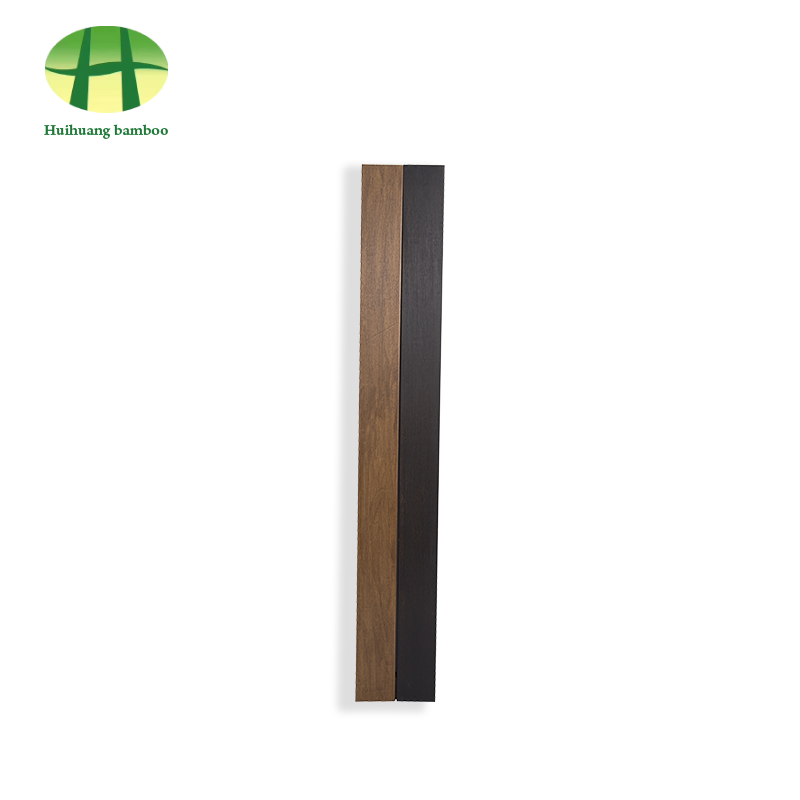 Custom Standard Size Glossy Heavy Bamboo Decking All Weather Durable Heavy Duty Ningguo Kuntai Bamboo and Wood Co.,Ltd. Offer Custom Standard Size Glossy Heavy Bamboo Decking All Weather Durable Heavy Duty Exterior Fl...View Product →
Dimensional Stability: The Board's Real Outdoor Test
Density and hardness describe strength; dimensional stability describes movement when wet. That is the difference between a deck that stays flat for a decade and one that gradually turns into a washboard.
The benchmark is EN 317, which measures thickness swelling after 24 hours of complete water immersion. For outdoor installation, thickness swelling should stay below 8 percent; 5 percent or less is very good. The more demanding EN 321 cycle test repeats water immersion, freezing, and drying several times and simulates a deck that survives winter and summer. Any board that delaminates at the edges during those cycles has failed its bonding test, whatever its Janka value says. The numerical limits and the test procedure are covered in our article on EN 317 thickness swell limits for bamboo decking.
Carbonized boards deserve attention here. The heat treatment that produces the dark color slightly lowers moisture absorption, which improves stability in humid coastal projects, at the cost of about 10 percent hardness. In dense shade or a damp microclimate, carbonized-color bamboo flooring is often the wiser specification.
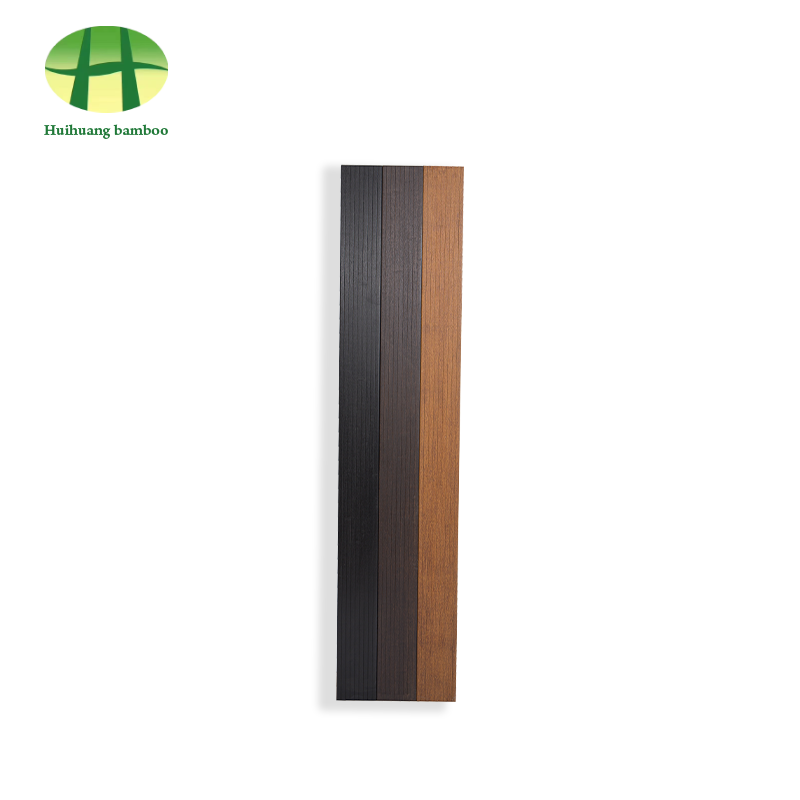
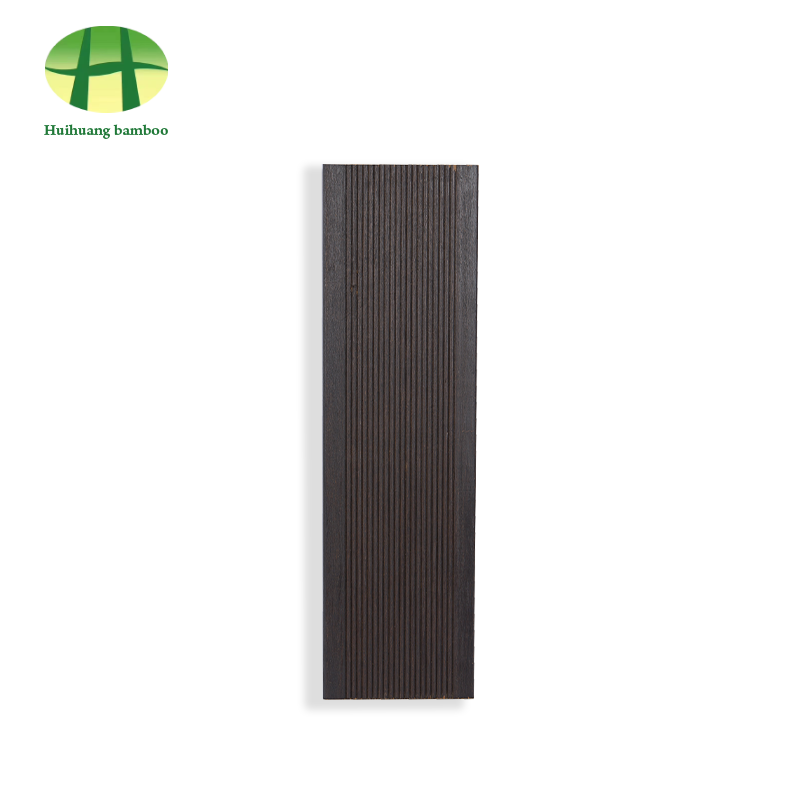 Custom eco friendly Carbonized color bamboo composite flooring Manufacturers, FaNingguo Kuntai Bamboo and Wood Co.,Ltd. Offer Custom eco friendly Carbonized color bamboo composite flooring Manufacturers and Factory In...View Product →
Surface Finish, Anti-Slip Profile, and UV Behavior
Coating and color stability
The coating is the first thing to inspect. Outdoor boards should carry a UV-cured acrylic or polyurethane finish on the face, edges, and end grain; the end grain is where water wicks into the core fastest, and poor edge coverage is a common cause of early delamination. A reasonable quality target is a color change of less than 5 units after 600 hours of xenon-arc exposure. Ask for that report before ordering, not after.
Anti-slip geometry
Smooth bamboo becomes slippery when wet, so anti-slip profiles cut grooves, waves, or stripes into the surface. For pool surrounds and covered steps, look for a wet slip resistance class of R11 or R12 according to DIN 51130. Grooves that are too shallow stop working after one season of dirt; grooves that are too deep collect debris and become hard to clean. A balanced small-groove pattern is the standard choice for the wettest zones of a deck; small-groove anti-slip bamboo flooring is the profile we choose beside pools and at the base of outdoor staircases.
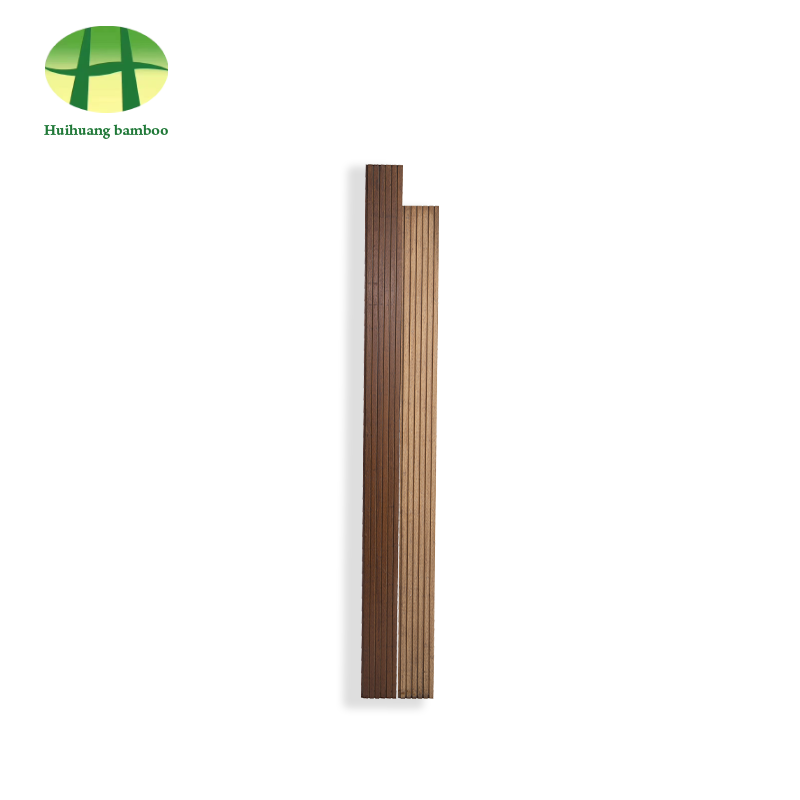
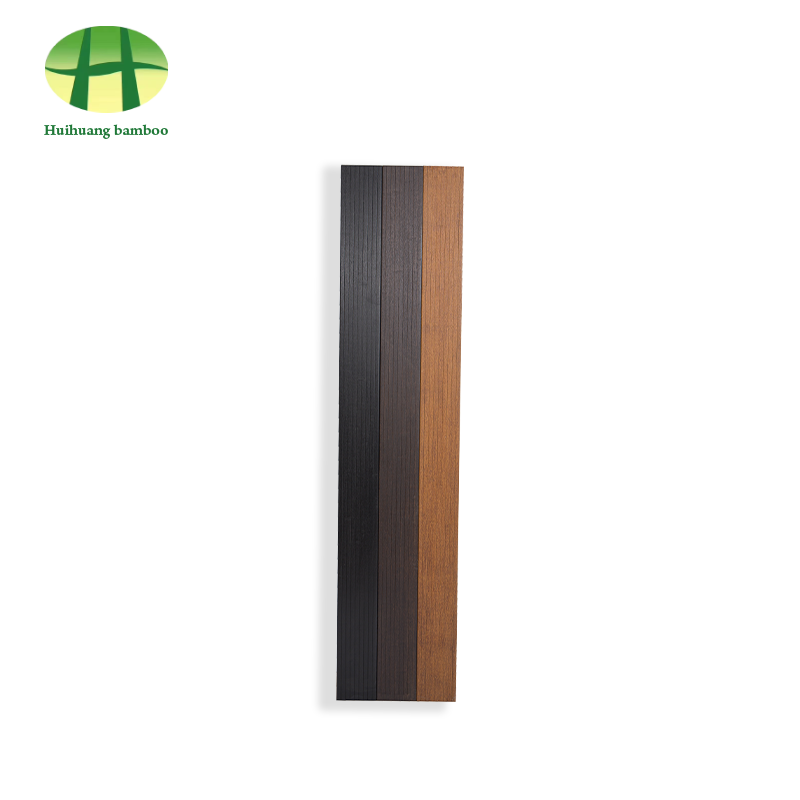 Custom High Density Carbonized Outdoor Bamboo Flooring With Small Grooves Anti SNingguo Kuntai Bamboo and Wood Co.,Ltd. Offer Custom High Density Carbonized Outdoor Bamboo Flooring With Small Grooves Anti Slip Wear Re...View Product →
Resin Type and Bonding: The Hidden Chemical Standard
The resin that binds the strands is the most critical chemical decision in the product. Interior bamboo flooring often uses urea-formaldehyde resin, which works indoors but hydrolyses when exposed to water, causing swelling and delamination at the edges. Outdoor strand woven bamboo should use phenol-formaldehyde or polymeric diphenylmethane diisocyanate, both of which survive repeated wet-dry cycling without losing adhesion.
Ask what resin system is in the specific boards you are buying, and what test proves the bond survives water: a boiling-water delamination test, EN 321 cycling, or an equivalent. For interior and semi-covered installations, formaldehyde emissions matter as well; E1 (0.124 mg/m³ per EN 717-1) or CARB Phase 2 compliance is a reasonable benchmark. A datasheet that says "no added urea formaldehyde" is a strong signal for outdoor suitability.
Certifications: Useful Only If You Read Them Correctly
Certifications are a pre-screen, not a substitute for batch inspection. FSC chain-of-custody confirms that the bamboo comes from a legal and sustainably managed source. CE marking under EN 14342 gives access to EU construction markets. ISO 9001 and ISO 14001 document quality and environmental management systems, and an SGS report can confirm batch data if the testing was run on your order.
But certificates describe systems and product types, not the boards in your container. Real quality lives in process control: drying schedules, resin dosing, pressing pressure, and batch testing frequency. A supplier that owns a patent on its outdoor bamboo flooring, as we do on our heavy bamboo decking, offers extra evidence that the board was engineered rather than just pressed. Ask which parameters are measured on every batch, and which are measured only after a complaint.
A Field Checklist for Buyers
The table below summarizes the thresholds we use when auditing strand woven bamboo decking. It is not a full factory audit; it is a quick desktop and warehouse check that takes less than an afternoon.
| Property | Suggested threshold | Quick verification |
|---|---|---|
| Moisture content | 6%–8% at factory; below 10% at delivery | Pin-type meter on 5% of the batch |
| Density | At least 1,100 kg/m³ | Weigh and measure a dry 20 cm by 20 cm sample |
| Janka hardness | Above 3,000 lbf | Review the laboratory certificate |
| Thickness swelling, 24 h immersion (EN 317) | Below 8%; very good is 5% | Laboratory test on one representative sample |
| UV color stability | Change below 5 units after 600 h xenon | Request the xenon-arc test report |
| Bonding resin | PF or PMDI for outdoor boards | Request technical and safety data sheets |
The bottom line is simple. Strand woven bamboo can be one of the most durable outdoor building materials available, harder than most hardwoods and lighter on carbon than tropical timber. But performance is only guaranteed when the board meets defined standards, and standards are only meaningful when the buyer verifies them. Check moisture content and density first, demand documented EN 317 and UV values, confirm the resin system, and treat certifications as a first filter rather than a final verdict. A supplier with mature process control will welcome these questions; one that hesitates is telling you something about the next batch as well.
 View More

 +86-572-5215066 5216895
 office@hh-bamboo.com
 East Side of Huanggang RD,Ningdun County, Ningguo ,Xuancheng City,Anhui Province,China.
