


 English
 Deutsch

Content
- 1 Why Supplier Selection Differs From Consumer Buying
- 2 The Specification Sheet: What a Procurement Team Must Verify
- 3 Certifications That Remove Risk
- 4 Manufacturing Capability Assessment
- 5 Supply Chain, MOQ, and Lead Time Factors
- 6 Quality Control and Inspection Protocol
- 7 The Commercial Decision Framework
- 8 Frequently Asked Questions
A procurement manager evaluating strand woven bamboo flooring for a 2,000-square-meter commercial terrace carries a task that goes far beyond comparing sample boards. The density, dimensional stability, coating, and certification the supplier can prove will decide whether the project survives ten years of rain, salt air, or high foot traffic. In B2B sourcing, supplier selection is really about transferring risk from the buyer to a manufacturing partner willing to document every claim.
Why Supplier Selection Differs From Consumer Buying
A homeowner selects strand woven bamboo flooring by looking at a sample and matching it to a room. A procurement team has to buy a production run that will arrive across multiple containers, in several batches, and still meet the specification written into the contract. The direct answer is that supplier selection is governed by risk transfer, not aesthetics.
A competent supplier publishes density, moisture content, and hardness values, and agrees to have those values re-verified at the factory during third-party inspection. A weak supplier shows a beautiful sample and avoids written tolerance commitments.
- Color and grain matching between production batches
- Guaranteed density range with third-party test data
- Factory-level moisture content monitoring
- Export packaging built for ocean freight and jobsite storage
The Specification Sheet: What a Procurement Team Must Verify
Every purchase order should start with a written specification table. Verbal descriptions are not enough when a 20-foot container carries 600 to 800 square meters of material.
Density and Structural Rating
Strand woven bamboo flooring commonly reaches a density of 1,050 to 1,200 kg/m3. A supplier should state the average density and the test method used. If density falls below the stated range during container-level inspection, the planks will absorb more moisture and become vulnerable to edge swelling and cupping.
Surface Hardness and Slip Performance
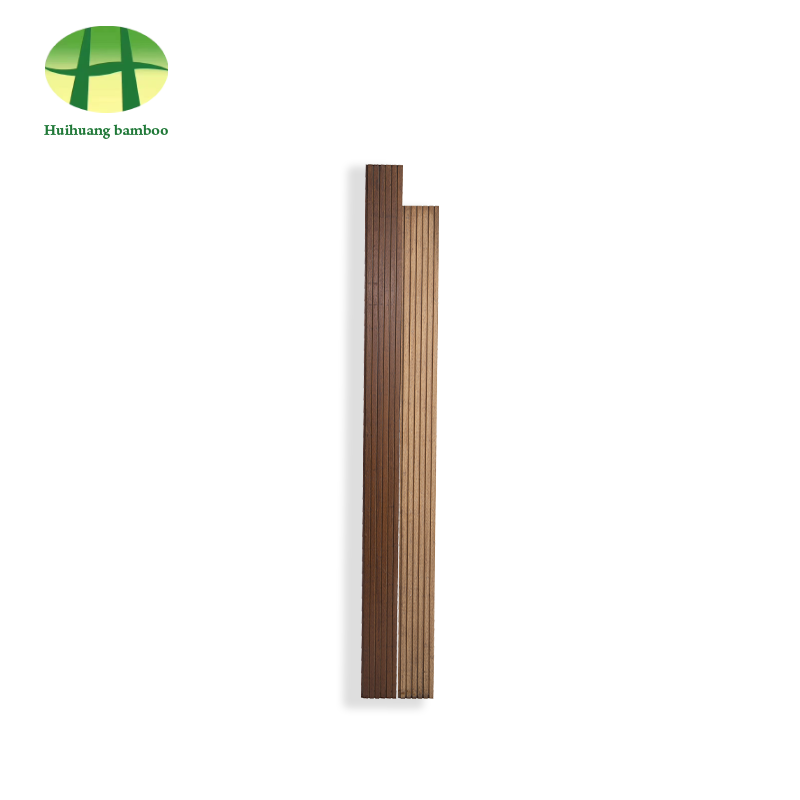
The Janka hardness of strand woven bamboo is often reported at 2,500 to 3,000 lbf, which is harder than most oak species. Hardness, however, does not solve wet-surface slip risk. Commercial outdoor decking specifications usually reference a slip resistance standard such as DIN 51130 or AS/NZS 4586. A dependable supplier documents the anti-slip profile and explains which groove type fits pool decks, boardwalks, or sloped terraces.
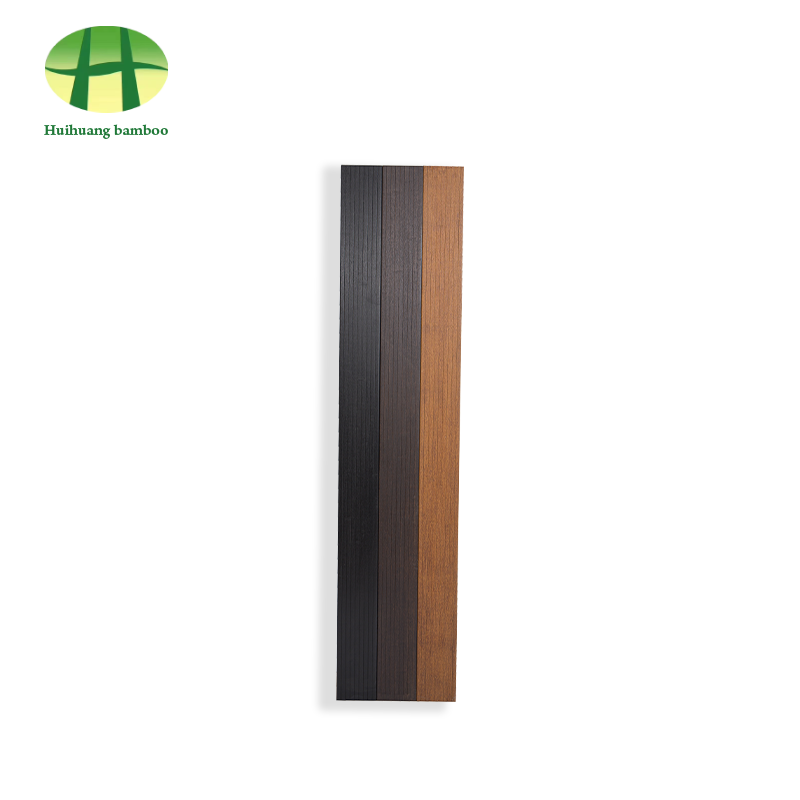 High-Density Carbonized Bamboo Flooring with Anti-Slip GroovesThis carbonized outdoor bamboo flooring features fine grooves for slip resistance, suitable for wet areas. It balances hardness with safety, addressing the slip risk noted in the preceding discussion and offering durable, easy-to-clean surfaces for commercial decks.View Product →
Moisture Stability and Warp Tolerance
The expansion coefficient of strand woven bamboo is lower than solid hardwood, but it is not zero. A B2B supplier should provide dimensional stability data, such as EN 317 thickness swelling values, and the recommended expansion gap for a fixed area. Ask for the internal tolerance limits the factory uses, and the percentage of boards rejected at final inspection.
Certifications That Remove Risk
Certifications are not decorative logos in a brochure. They are the evidence trail a project consultant, architect, or building standard inspector will ask for during tender evaluation. The decay resistance of strand woven bamboo flooring is directly tied to density and resin content, which is why the certification file has to be reviewed together with the technical data sheet.
| Certification | What it proves | Procurement relevance |
| FSC | Chain of custody and sustainable sourcing | Required in many EU tenders and green building programs |
| ISO 9001 | Quality management system | Confirms repeatable production and defect monitoring |
| ISO 14001 | Environmental management | Supports sustainability reporting and waste control |
| CE | European conformity | Verifies compliance with EU product performance standards |
| SGS or third-party report | Independent verification | Replaces reliance on the supplier's own internal claims |
Manufacturing Capability Assessment
The most important metric is vertical integration. A factory that controls fiber preparation, pressing, heat treatment, sanding, and edge profiling can commit to a density range with far less batch risk than one that assembles boards from outsourced components. A production base of 30,000 square meters and a workforce of more than 100 indicates a plant that runs multiple press lines and keeps drying capacity inside the facility.
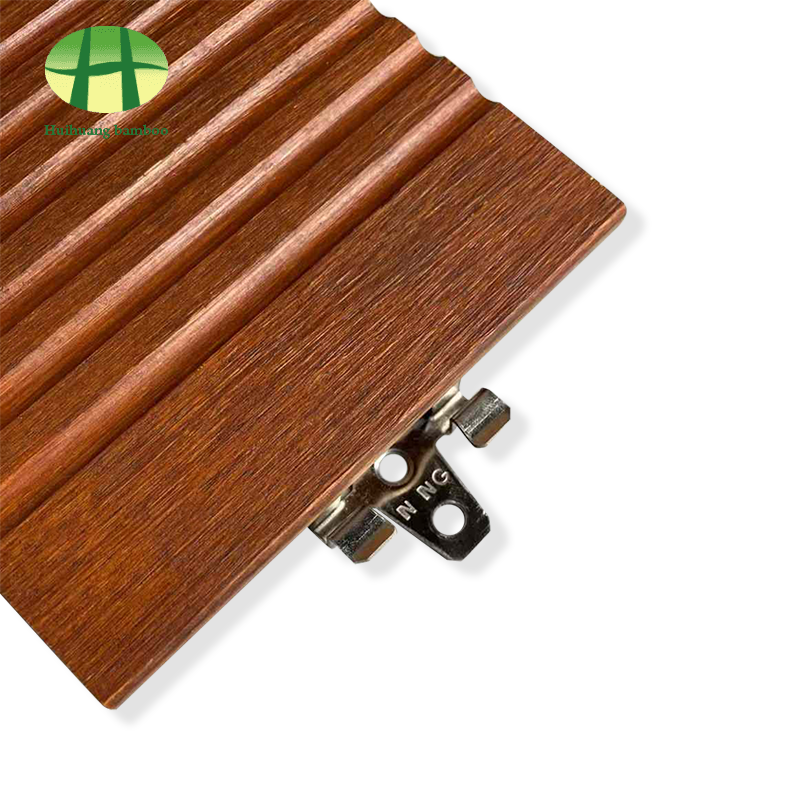 Vertically Integrated Bamboo Flooring Manufacturer for Reliable SupplyAs a dedicated bamboo flooring manufacturer, the facility controls fiber preparation through finishing, backed by a 30,000 m² plant and 100+ workers. This vertical integration supports consistent density and dimensional stability, essential for large outdoor projects.View Product →
For an outdoor decking supplier, the ability to produce thicker planks and long lengths is also a capability signal. Standard planks run at 1,860 by 139 by 18 mm, but boardwalk and marina projects often require custom dimension profiles. A factory with in-house pressing and sanding lines is more willing to accept these requests.
Supply Chain, MOQ, and Lead Time Factors
Procurement managers need a commercial picture that includes minimum order quantity, production lead time, and freight window. For strand woven bamboo flooring, the practical MOQ is one 20-foot container, which carries roughly 600 to 800 square meters depending on profile and packing density.
Custom colors, special groove patterns, or non-standard lengths will raise both MOQ and lead time by two to four weeks. A strong supplier tells you a realistic timeline rather than over-promising a shorter window.
Quality Control and Inspection Protocol
A standard pre-shipment inspection for strand woven bamboo flooring should cover surface finish, dimension, density, and moisture content. The procedure a buyer should validate with a factory looks like this:
- Visual inspection of surface finish, color consistency, and edge damage
- Dimensional check for thickness, width, length, and squareness
- Random sampling for density and moisture content measurement
- Coating adhesion test on planks cut from both ends of the press run
The humidity response of outdoor bamboo versus hardwood is a useful reference when specifying expansion gaps and drainage details.
The Commercial Decision Framework
When comparing quotes across suppliers, separate the aesthetics evaluation from the contractual evaluation.
Materials-first negotiation
- Starts with the sample board
- Compares visual color and grain
- Discusses price per square meter
- Accepts the supplier's coating system as given
Factory-first negotiation
- Starts with the specification sheet
- Compares density, stability data, and certifications
- Discusses price, MOQ, and re-inspection terms
- Validates the coating and surface process capability
Frequently Asked Questions
What density should B2B buyers require from strand woven bamboo flooring?
Outdoor project specifiers typically require a density range of 1,050 to 1,200 kg/m3. The supplier should submit a test report rather than a brochure value, and agree to re-verify density at pre-shipment inspection.
Which certifications matter most for international strand woven bamboo projects?
FSC for chain of custody, CE for EU market entry, ISO 9001 for quality management, and ISO 14001 for environmental controls. For US projects, certification is less central; third-party test reports and a US patent on the flooring construction can substitute.
What is a realistic MOQ for strand woven bamboo flooring?
Factory minimum is usually one 20-foot container, or about 600 to 800 square meters. A buyer can typically mix a limited number of colors or profiles within that container. Custom dies or special surface treatments raise both MOQ and lead time.
How should a procurement team verify coating adhesion?
Use a cross-cut adhesion test on samples from each production batch. Water-based UV-cured coatings behave differently on strand woven bamboo than on solid hardwood, so the test method must match the coating type.
 View More

 +86-572-5215066 5216895
 office@hh-bamboo.com
 East Side of Huanggang RD,Ningdun County, Ningguo ,Xuancheng City,Anhui Province,China.
