


 English
 Deutsch
Content
- 1 What Adhesive Performance Means in Strand Woven Bamboo Flooring
- 2 Resin Chemistry Decides Whether a Board Survives Outdoors
- 3 Strip Moisture Content: The Variable That Quietly Breaks Bonds
- 4 Hot Pressing Parameters Complete the Cure
- 5 Testing Thresholds That Separate Good Boards From Faulty Ones
- 6 A Buyer Checklist Before Committing to a Container
- 7 Frequently Asked Questions
Two pallets of strand woven bamboo flooring can leave the same port with identical Janka hardness values above 3,000 pounds and still behave like entirely different products after two seasons outdoors.
The board that stays flat and the board that opens hairline cracks along its glue lines usually differ in one variable: adhesive performance. Importers who evaluate resin chemistry, strip moisture, and press discipline before ordering rarely receive delamination claims. Importers who buy on hardness numbers alone eventually do.
This guide breaks down the four factors that decide whether that adhesive holds up: resin type, strip moisture content, hot pressing parameters, and verification testing.
What Adhesive Performance Means in Strand Woven Bamboo Flooring
Adhesive performance is the capacity of the cured resin inside a board to keep bamboo strands bonded through moisture cycling, heat, and mechanical load without separating.
Strand woven bamboo is not sliced veneer glued onto a core. Mills harvest 4 to 6 year old Moso culms, crush them into long fiber strands, dry the strands, dip them in liquid thermosetting resin, bundle the coated strands into blocks, and cure those blocks in a hot press at roughly 140 to 160 degrees Celsius. The resin becomes the matrix that transfers load between fibers, so its quality is inseparable from product stability.
Adhesive performance: the measured ability of a cured resin system to preserve bond integrity in strand woven bamboo under water exposure, temperature swings, and sustained load, normally verified through boil-dry-freeze delamination testing and thickness swelling limits.
When the bond underperforms, the symptoms follow a predictable pattern: edge checking during the first wet season, plank gaps that never close again, cupping after rain, and in advanced cases full delamination where the board splits back into visible strands. Every one of these traces back to glue, even when the surface finish and hardness readings look flawless.
The complete production route, from culm selection to final sanding, is covered in this overview of how stranded bamboo flooring is made.
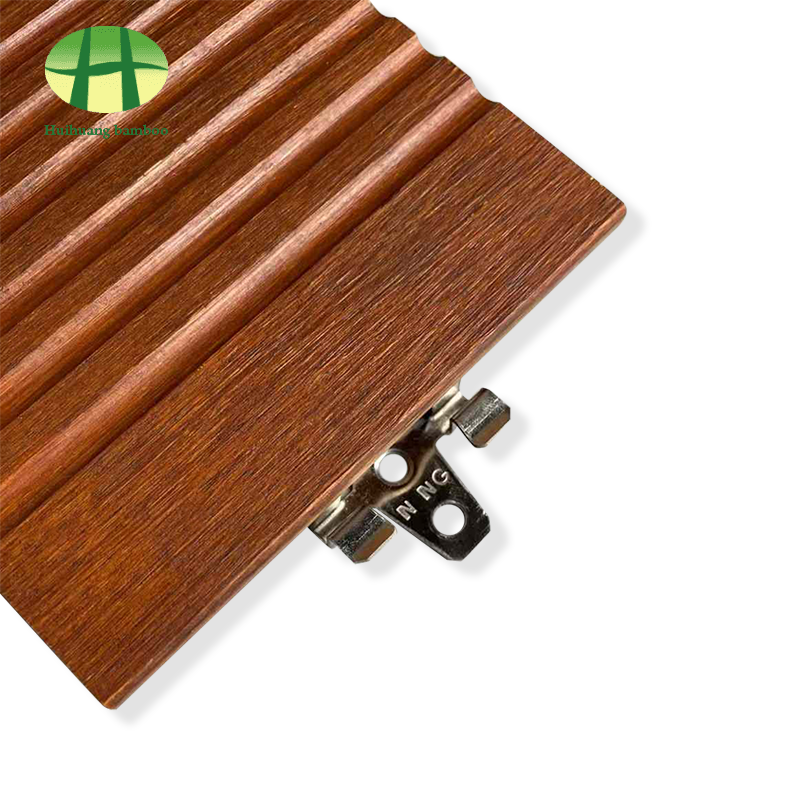 Strand Woven Bamboo Flooring ManufacturersHeavy strand woven bamboo flooring made under high temperature and pressure offers density, strength and outdoor durability. It suits this overview of the full production route from culm selection to final sanding.View Product →
Resin Chemistry Decides Whether a Board Survives Outdoors
Exterior-grade phenol-formaldehyde resin is the default for outdoor strand woven bamboo because it cures into a boil-proof bond, while cheaper urea-based systems lose strength when repeatedly wetted.
Phenol-formaldehyde (PF) resin produces a dark, reddish glue line that blends naturally with carbonized decking tones, and it is the same bond class required for exterior plywood service. That matters because a deck, boardwalk, or fence face boil-dry-freeze cycling that no interior adhesive formula was designed to survive.
- Boil-proof bond rated for wet exterior service
- Passes cyclic boil-dry-freeze delamination testing
- Dark glue line suits carbonized and natural decking
- Higher resin and pressing cost, justified outdoors
- Engineered for dry interior service
- Bond strength drops after repeated wetting cycles
- Light glue line at a lower cost
- Suitable for indoor floors, not decking
Adhesive chemistry also drives emissions. European E1 certification caps formaldehyde at 0.124 mg per cubic meter, and projects in California or Japan often require CARB Phase 2 or the Japanese four-star class. Well-cured PF systems generally release less free formaldehyde than urea systems, which is a second reason outdoor grades favor them.
Strip Moisture Content: The Variable That Quietly Breaks Bonds
When bamboo strands enter the press too wet or too dry, resin penetration turns uneven, and the finished board carries starved glue lines that later appear as instability and irregular off-gassing.
Over-wet strands dilute the resin and generate steam pockets during pressing, which leaves voids and blisters inside the block. Over-dry strands act like a sponge, wicking resin deep into the fiber and leaving too little adhesive in the actual glue line. Such a board can measure perfectly on the day it ships and still fail one season later, which is why mature mills hold strand moisture inside a narrow window, commonly near 10 to 12 percent with a tolerance of roughly two percentage points.
Culm maturity adds to the equation. Bamboo harvested at 4 to 6 years carries denser fiber and more stable starch content than young culms, so it dries predictably and keeps moisture uniform from batch to batch.
Hot Pressing Parameters Complete the Cure
Resin only becomes a durable bond when temperature, pressure, and press time match the mat conditions; an under-cured core fails boil and swelling tests even when the surface looks excellent.
| Parameter | Typical working range | Failure mode when off-spec |
| Press temperature | 140-160 degrees Celsius | Under-cured core, surface blistering |
| Press pressure | 4-5 MPa | Low density and weak internal bond, or brittle over-compressed edges |
| Press time | Scaled to thickness and mat moisture | Core separation in boil testing |
| Strip moisture at press | Roughly 10-12 percent | Uneven penetration, steam pockets |
| Post-press conditioning | Balanced stack, shaded cooling | Warping from uneven heat release |
The same discipline applies to secondary bonding. Spliced boards, where planks are joined into wider panels, depend on glue line quality at every joint, so jointed products deserve exactly the same scrutiny as the base board.
Spliced Heavy Bamboo Flooring SuppliersModular spliced panels connected by fasteners or exposed nails allow easy installation, removal and local repair. Glue line quality at every joint makes verification documents essential for these wider panels.View Product →
Testing Thresholds That Separate Good Boards From Faulty Ones
Four documents let a buyer verify adhesive quality before shipment: a boil-dry-freeze delamination report, EN 317 thickness swelling data, an internal bond strength figure, and a formaldehyde class certificate.
- Delamination, boil-dry-freeze cycle: the bonded block is boiled, dried, and frozen through repeated cycles; a pass means zero visible separation at any glue line.
- EN 317 thickness swelling: a 24-hour water soak measured in percent; many outdoor specifications cap it near 2 percent, and premium batches report under 1.5 percent.
- Internal bond strength: the force needed to pull the board apart across its thickness; low values expose under-cured resin hidden in the core.
- Formaldehyde class: E1 as the baseline, with CARB Phase 2 or stricter documentation for sensitive installations.
Typical 24-hour thickness swelling by bond quality
The numbers behind those limits are explained further in this breakdown of EN 317 stability limits for outdoor bamboo flooring. Third-party SGS reports and CE marking only carry meaning when the adhesive tests behind them are current and batch-specific.
Wet-zone installations such as pool surrounds and boardwalks place maximum stress on glue lines, which is why anti-slip patterned boards for those areas should be ordered only with exterior-grade test documentation attached.
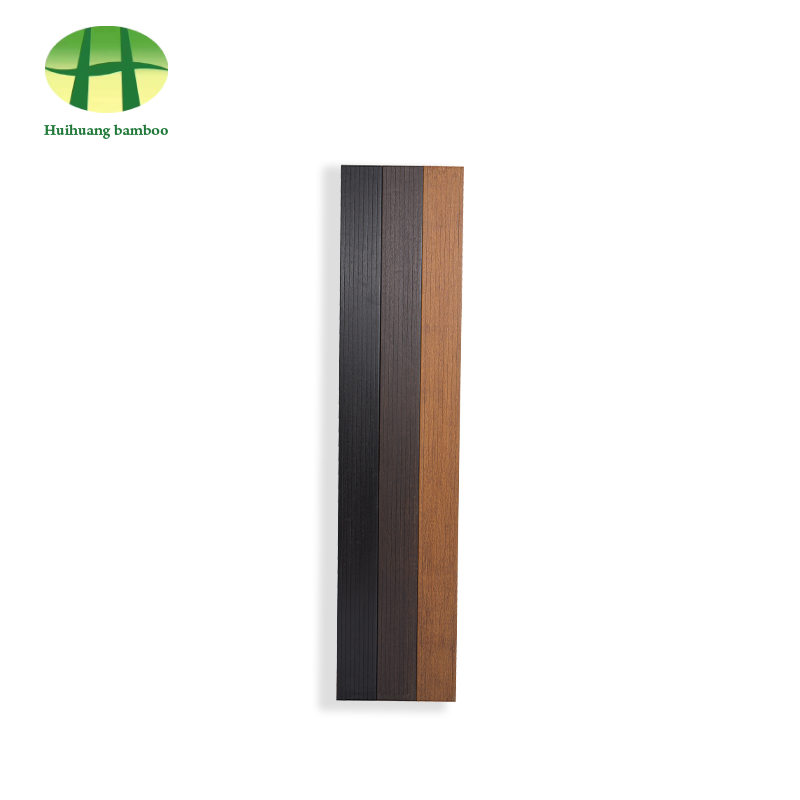 Anti-Slip Outdoor Bamboo Decking SuppliersGrooved and textured bamboo decking increases friction for wet areas like poolsides and boardwalks. Exterior-grade adhesive documentation should accompany orders for these maximum-stress wet-zone installations.View Product →
A Buyer Checklist Before Committing to a Container
Five written confirmations remove most adhesive risk: resin type, batch test reports, moisture records, certification scope, and a delamination warranty.
- Resin specification: exterior-grade phenolic named explicitly in the spec sheet.
- Batch test reports: delamination, EN 317 swelling, and internal bond values for the actual production batch, not a five-year-old average.
- Moisture control records: strip moisture logs for the pressing run in question.
- Certification scope: FSC, CE, SGS, and ISO 9001 certificates matched to the exact factory that will press the order.
- Independent sample check: boil a sample plank at your own facility and inspect every glue line before releasing the balance payment.
Suppliers with their own pressing lines can answer all five within days. Huihuang Bamboo (Ningguo Kuntai Bamboo and Wood Co., Ltd.) has manufactured outdoor strand woven bamboo products in Ningguo, Anhui Province, since 2002, operates a 30,000 square meter factory under FSC, CE, SGS, and ISO 9001 certification, and holds US Patent 11,148,318 for outdoor bamboo decking. The company welcomes buyers to visit the plant and audit pressing conditions in person.
Frequently Asked Questions
Which adhesive should outdoor strand woven bamboo flooring use?
Exterior-grade phenol-formaldehyde resin. It cures boil-proof bonds that survive cyclic wetting and freezing, and it generally emits less free formaldehyde than urea-based chemistry. Confirm the resin type in writing before production begins.
Can buyers test adhesive quality without a laboratory?
Yes. Boil a sample plank for two to four hours, dry it, then inspect the glue lines under strong light. Any visible separation, blistering, or layer opening is a fail. Measure the plank before and after soaking to estimate thickness swelling against a 2 percent benchmark.
Does stronger adhesive mean higher formaldehyde emissions?
No. Phenol-formaldehyde systems used in exterior-grade boards generally release less free formaldehyde than the urea-formaldehyde glues common in interior panels. Verify with an E1, CARB Phase 2, or equivalent certificate tied to the production batch.
Why did a hard board delaminate if the Janka rating was high?
Hardness measures surface density resistance, while delamination is a bond property. A board can score above 3,000 pounds on the Janka scale and still split along under-cured or moisture-starved glue lines. The two results come from different tests and must be verified separately.
 View More


 +86-572-5215066 5216895
 office@hh-bamboo.com
 East Side of Huanggang RD,Ningdun County, Ningguo ,Xuancheng City,Anhui Province,China.