


 English
 Deutsch
Content
- 1 Raw Material Selection Sets the Quality Ceiling
- 2 Strand Woven Densification Is the Core Quality Gate
- 3 Moisture Control and Dimensional Stability in the Factory
- 4 Surface Treatment and Slip Safety Underfoot
- 5 Certification and Third-Party Verification
- 6 Factory Capability Behind the Quality Claim
- 7 Frequently Asked Questions
A facilities manager testing bamboo decking samples from three suppliers pulled one board out of the humidity chamber after a 72-hour soak: edge swell came in at 4.1 percent, with no delamination and no surface cracking. The other two boards failed the same test by a wide margin. The difference was not the bamboo species. It was production control: harvest age, fiber density, pressing pressure, adhesive load, and moisture conditioning. For buyers evaluating outdoor bamboo flooring, understanding how a manufacturer manages those steps is the fastest way to separate an engineered product from surface gloss.
Raw Material Selection Sets the Quality Ceiling
Quality bamboo flooring is decided before pressing begins, because a manufacturer that cannot control raw culm selection cannot control anything that follows.
Strand woven bamboo flooring starts with moso bamboo, Phyllostachys pubescens. Mills that supply decking boards typically harvest culms at 4 to 6 years of age. At that stage, cell walls are thick, fiber density is high, and the stalk still machines cleanly. Younger bamboo is softer and contains more sugar and starch, which lowers decay resistance. Old bamboo turns brittle and absorbs resin unevenly. Harvest month matters as well: winter cutting, when sap flow drops, leaves fewer nutrients available to insects and fungi.
Huihuang Bamboo, the export brand of Ningguo Kuntai Bamboo and Wood Co., Ltd., sources its material in Ningguo, Anhui, a region known for dense bamboo forest cover. Being close to the harvest area means culms are processed quickly after cutting, and each batch can be traced back to its growing plot. That proximity is a quality advantage that never appears in the product photos.
What serious mills check at harvest
- Culm age and diameter records per harvest lot.
- Winter harvest timing and a documented cutting schedule.
- Distance from the forest to the mill, to keep fresh-cut transport time short.
- FSC chain-of-custody coverage for the sourcing area.
Raw bamboo grades at a glance
Suppliers that grade culms by age and condition are the minority. The table below shows why that grading decision changes the finished board.
| Attribute | 2 to 3 years | 4 to 6 years | 7 years and older |
| Fiber density | Low to moderate | High | Declining |
| Sugar and starch | High, attracts pests | Low after winter harvest | Low |
| Dimensional stability | Unstable in humidity cycles | Stable | Brittle fibers |
| Mill acceptance | Rejected by quality factories | Standard grade | Limited uses |
A board is only as stable as the culm it came from. Factories that document bamboo age, harvest season, and source area can explain their product. Factories that cannot usually cannot explain their defects either.
Strand Woven Densification Is the Core Quality Gate
The step that defines bamboo decking quality is densification, where crushed bamboo strands are glued, compressed, and cured into a board with a density of 1,100 to 1,200 kg/m3.
Manufacturers split the culm, crush it into fiber strands, and dry those strands to a controlled moisture level. The strands are then dipped in phenolic resin, laid into a steel mold, and hot-pressed under heavy force. Heat cures the resin and fuses the fiber network into a single dense slab. The three variables that decide whether that slab performs are pressure, temperature, and dwell time. Pressure that drops mid-cycle creates internal voids. Incorrect curing produces boards that warp or split after the first humid week.
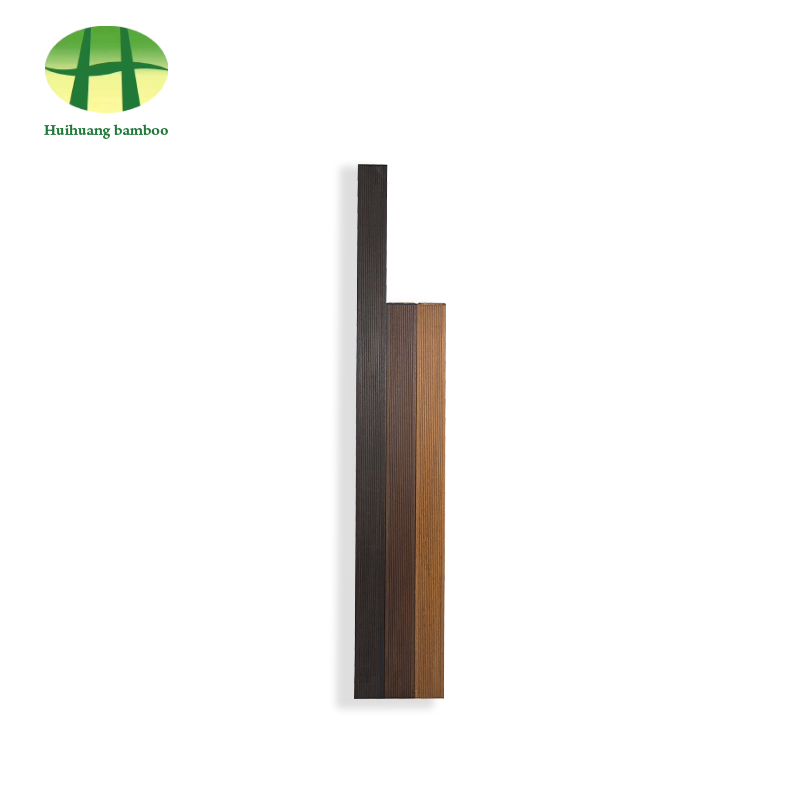
The same stage produces carbonization. Heat treatment darkens the strands before pressing, so the color runs through the full board instead of sitting on the surface. Carbonized boards also absorb less water because the treatment removes part of the hemicellulose, which is why the dark version is usually specified for uncovered terraces. Huihuang Bamboo's outdoor strand woven bamboo decking is pressed from this same densified core, with groove, wave, and smooth profiles boxed from a single production batch.
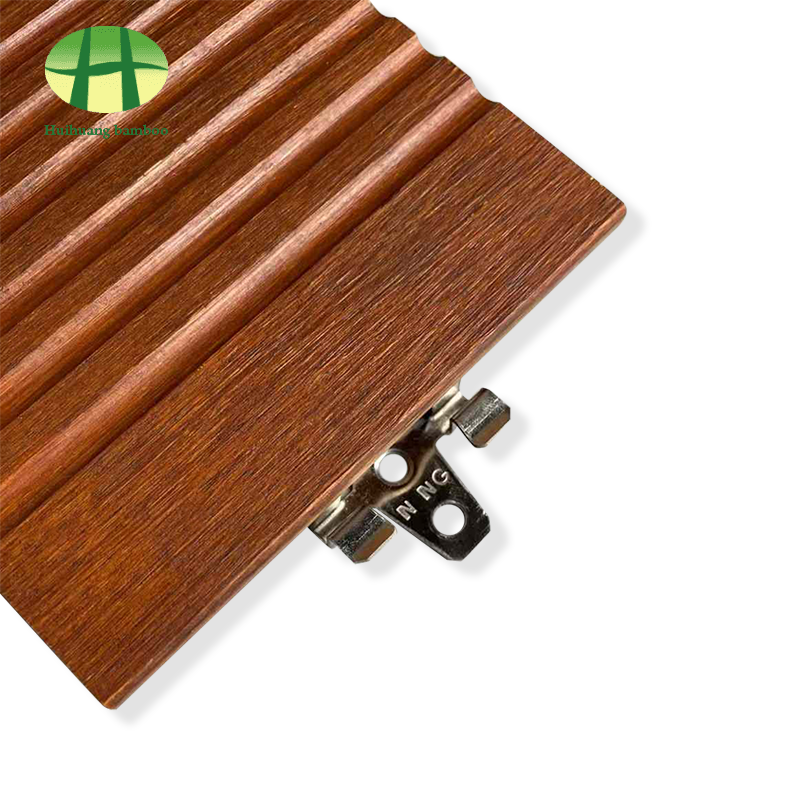 Bamboo Wood Flooring, Bamboo Composite Decking ManufacturersNingguo Kuntai Bamboo And Wood Co.,Ltd. Is China Bamboo Wood Flooring, Bamboo Composite Decking Manufacturers, Factory, We Offer Custom B...View Product →
Density is the single number that ties the whole process together. A strand woven board quoting below 1,000 kg/m3 has not reached the consolidation needed for outdoor loads. The 1,100 to 1,200 kg/m3 range is what buyers should specify in the procurement sheet.
Moisture Control and Dimensional Stability in the Factory
Dimensional stability is manufactured, not discovered: a board that leaves the factory with the wrong internal moisture field will cup, gap, or bow regardless of how carefully it is installed.
After pressing, a strand woven board still carries heat and internal stress. Quality factories let freshly pressed boards condition for several days so moisture equalizes through the full thickness. Then each batch is machined to final dimensions and checked. The number to care about is dispatched moisture content: 8 to 12 percent is the accepted range for outdoor decking in most climates. Outside that window, the board keeps moving, and movement in a fastened deck means gaps, raised edges, and fastener stress.
The EN 317 immersion test is the closest thing the industry has to a uniform benchmark. Production samples are soaked for 24 hours and measured for thickness swelling. Boards under 5 percent are accepted for exposed outdoor use. Swelling in the 8 to 10 percent range signals weak resin penetration and will eventually show up as surface checking.
Checkpoints a quality factory records on every batch
- Incoming moisture check on dried bamboo strips before resin application.
- Weighed resin loading per batch with a documented mix record.
- Press-cycle logging for pressure, temperature, and dwell time.
- Multi-day post-press conditioning to equalize internal moisture.
- Edge trimming and density sampling from the middle of each batch.
- Random 24-hour water immersion tests on finished boards.
Ask for the EN 317 thickness swelling report, the density certificate, and the moisture content readings of the current production batch. A supplier that cannot provide all three documents is selling samples, not a process.
Surface Treatment and Slip Safety Underfoot
Slip resistance is engineered into the surface profile during pressing, not brushed on after the fact, and that distinction decides how long a deck stays safe in wet conditions.
Anti-slip bamboo decking gets its grip from mechanical detail. Small and large grooves, wave profiles, and double-stripe channels drain water off the surface and create edges that a shoe sole can grip. A smooth board belongs under covered roofs and in transition zones, where standing water is rare. The difference matters on pool decks, boat docks, and fully rain-exposed terraces.
Surface finish interacts with the process too. Precision sanding opens the dense strand structure into a tactile texture, and carbonized boards keep their dark color through the full thickness, so heavy foot traffic never exposes a pale inner layer. When a project specification raises slip resistance, the surface profile is what the design should reference, not a post-applied coating.
| Profile | Wet traction | Barefoot feel | Cleaning effort | Best use |
| Smooth | Low | High | Low | Covered patios, transitions |
| Small groove | Moderate | High | Moderate | Residential terraces |
| Large groove | High | Moderate | Moderate | Pool surrounds |
| Small wave | High | Moderate | Higher | High-runoff terrace areas |
| Double stripe | High | Moderate | Higher | Coastal decks, boardwalks |
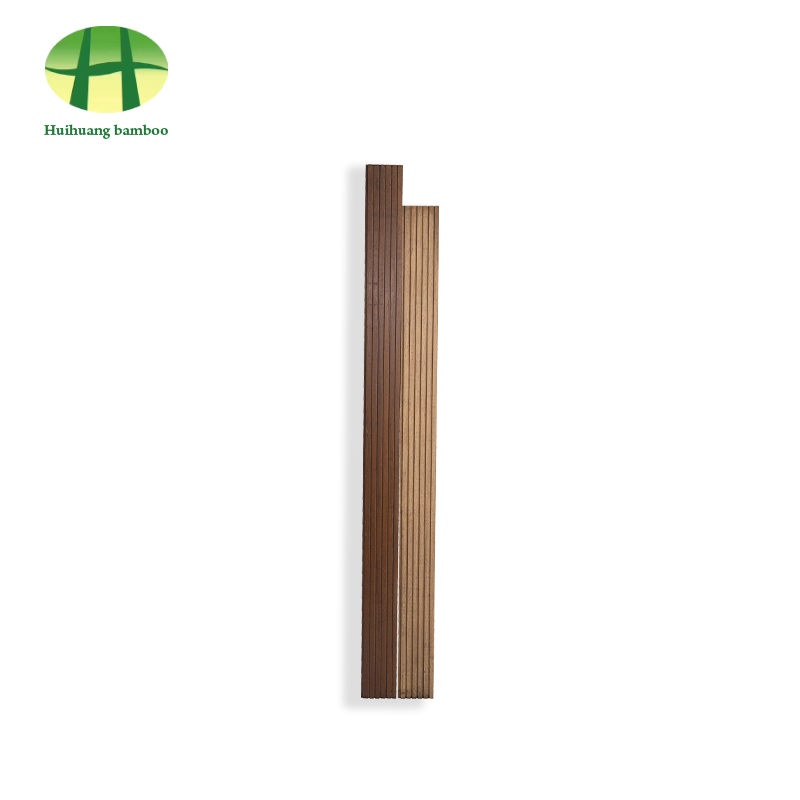
Huihuang Bamboo's small-wave anti-slip bamboo flooring is a direct example of a profile engineered at the pressing stage rather than added in finishing.
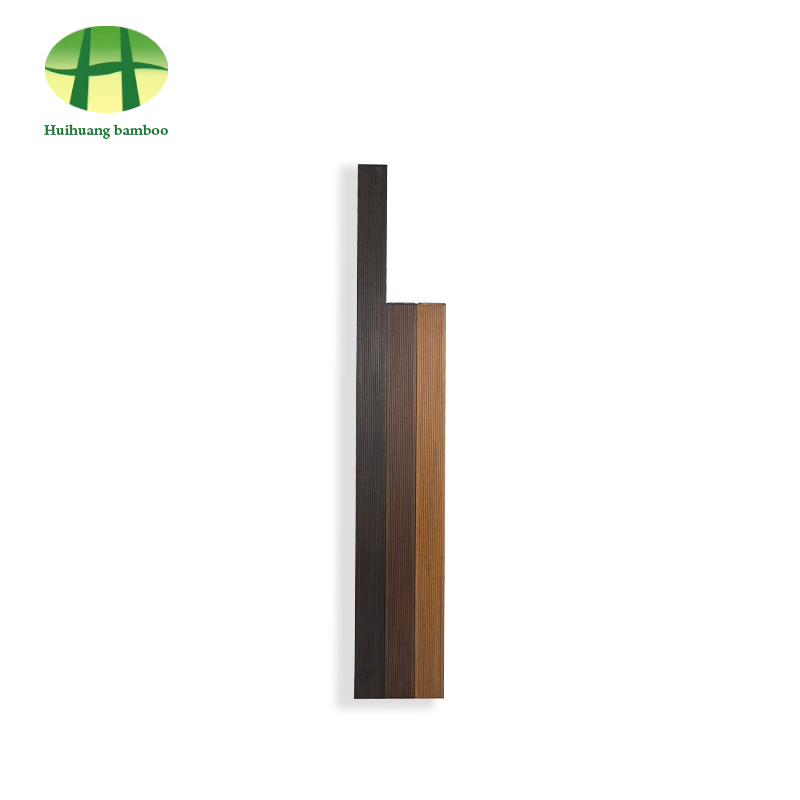 Custom Vertical Fine Small Wave Groove Bamboo Deck Good Slip Resistance For Wet Ningguo Kuntai Bamboo and Wood Co.,Ltd. Offer Custom Vertical Fine Small Wave Groove Bamboo Deck Good Slip Resistance For Wet Poolside Co...View Product →
Certification and Third-Party Verification
Certification converts a factory's own quality claims into commitments that an external body has checked, and for export buyers it is the fastest pre-audit filter.
Huihuang Bamboo publishes the full set: FSC for raw material chain of custody, CE for conformity in the European construction market, ISO 9001 and ISO 14001 for production and environmental management systems, and SGS for independent inspection. Ningguo Kuntai Bamboo and Wood Co., Ltd. is also the licensed Chinese manufacturer and exporter of US patent US11148318, which covers outdoor bamboo decking construction. For a buyer, the patent matters because it signals that the factory works to a specific engineered specification rather than a commodity recipe.
What a buyer should verify in a certificate
- Certificate scans with registration numbers, not just logos.
- Certificate scope that actually covers outdoor bamboo decking.
- Issuing body and validity dates on every document.
| Certificate | What it verifies | Why it matters |
| FSC | Raw material chain of custody | Proves a legal, sustainable bamboo source |
| CE | Conformity for European construction use | Market access for EU projects |
| ISO 9001 | Production quality management system | Consistent process control across batches |
| ISO 14001 | Environmental management system | Supports green building credit claims |
| SGS | Independent batch inspection | Third-party evidence beyond supplier claims |
The most useful message a buyer can send is short: request the certificate scans with registration numbers and the EN 317 report for the current production month. The gap between a manufacturer that answers with documents and a trader that answers with promises is exactly the gap in product quality.
Factory Capability Behind the Quality Claim
A quality system is only credible when the manufacturing process runs under the supplier's own roof, from raw culm to packed, moisture-conditioned boards.
Ningguo Kuntai Bamboo and Wood Co., Ltd. has operated the Huihuang Bamboo brand since 2002. Its KUNTAI factory in Ningguo covers about 30,000 square meters and employs more than 100 people. Under that roof, the company produces outdoor strand woven decking, wall panels, fencing, stable boards, planter boxes, and louvered pergolas. Because the whole chain is in-house, a batch can be traced from the bamboo plot to the finished bundle, and quality issues are caught at the press instead of on a job site.
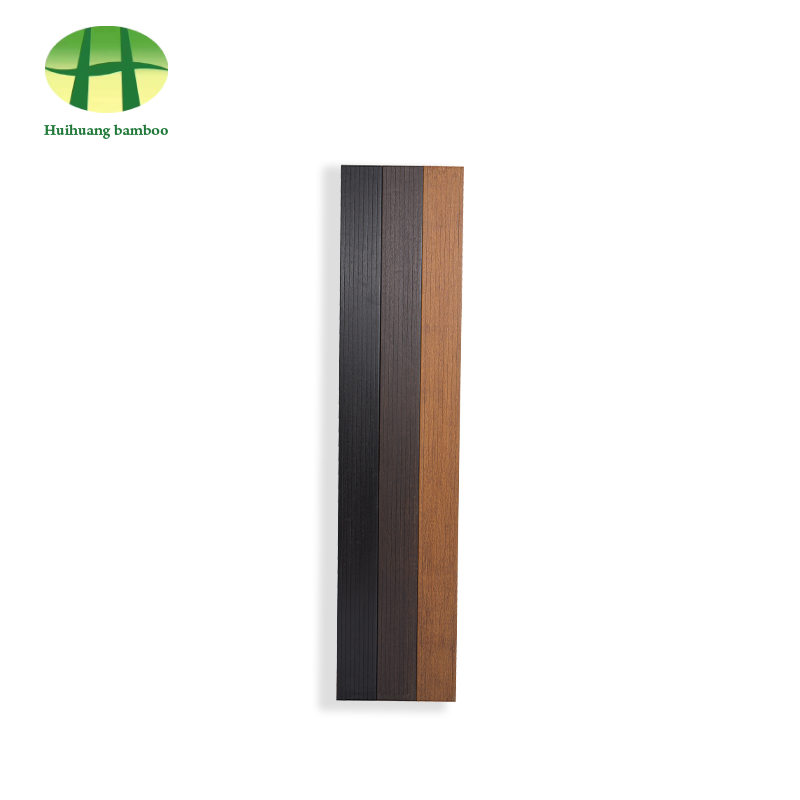
Factory capability also includes installation support. Boards engineered for nail splicing, fastener splicing, or specific mounting orientations come with documented instructions, and the manufacturer supplies the data sheet together with the product. For covered terraces and indoor-outdoor transitions, Huihuang also produces carbonized glossy bamboo flooring with the same densified core and a smooth, uniform surface. Buyers can review the manufacturer's complete outdoor bamboo product range before requesting samples, which keeps the first evaluation short and focused on what the factory actually builds.
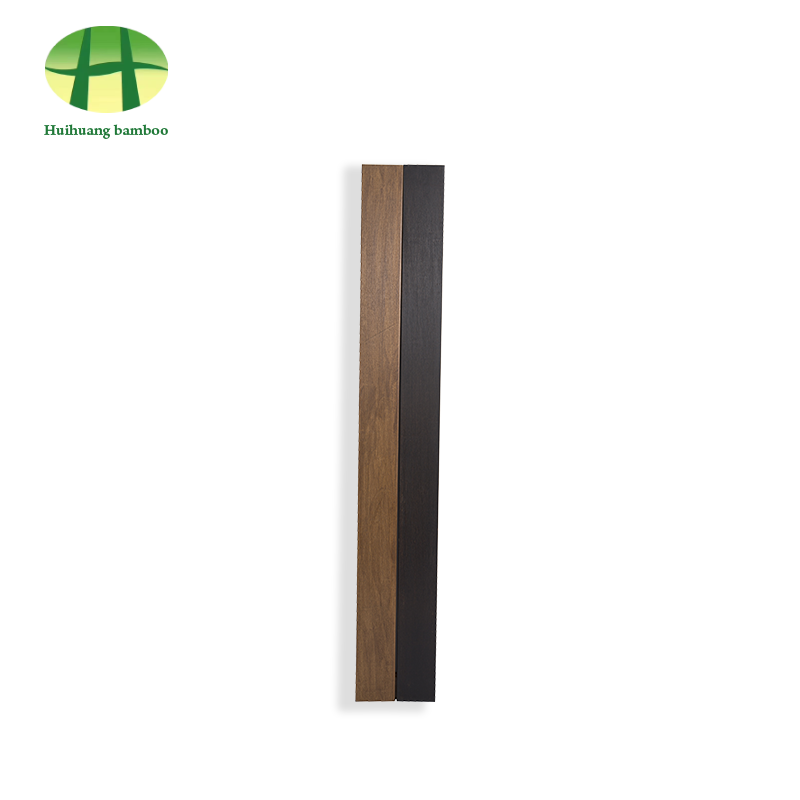 Custom Carbonized Color Glossy Heavy Bamboo Decking Durable Outdoor Flooring ManNingguo Kuntai Bamboo and Wood Co.,Ltd. Offer Custom Carbonized Color Glossy Heavy Bamboo Decking Durable Outdoor Flooring Manufacturers ...View Product →
Frequently Asked Questions
What density should quality strand woven bamboo flooring have?
A quality strand woven board measures between 1,100 and 1,200 kg/m3. Below 1,000 kg/m3, the material has not been consolidated well enough for reliable outdoor performance, so density belongs in the first round of supplier questions.
How do bamboo flooring manufacturers test moisture resistance?
The common benchmark is EN 317, a 24-hour water immersion test that measures thickness swelling. Boards under 5 percent swelling are accepted for exposed outdoor use. Buyers should request the latest batch report rather than a marketing sheet.
Is FSC certification necessary for bamboo flooring?
FSC is not a legal requirement in most markets, but it proves that the raw bamboo was harvested legally and that the supply chain is traceable. Export brands serving European and North American projects, such as Huihuang Bamboo, carry it as standard.
Which documents should a buyer request before ordering?
Request the FSC certificate with registration number, the CE declaration of performance, ISO 9001 and ISO 14001 certificates, the US patent reference where the product claims patented construction, and the latest EN 317 report for the production batch under consideration.
Quality summary: compare density, moisture control, surface profile, and certification across suppliers. Those four numbers tell a buyer more about a bamboo flooring factory than any brochure.
 View More

 +86-572-5215066 5216895
 office@hh-bamboo.com
 East Side of Huanggang RD,Ningdun County, Ningguo ,Xuancheng City,Anhui Province,China.