


 English
 Deutsch

Content
Install a strand woven click bamboo floor in a room that holds 35% relative humidity through the winter and you will see the click joints open before spring. The boards resist dents, but a click profile transfers every dimensional change of the panel into the joint geometry. The real specification for this material is not the color chart; it is the installation and performance envelope around it.
Huihuang Bamboo, the export brand of Ningguo Kuntai Bamboo and Wood Co., Ltd., has manufactured strand woven bamboo products in Anhui, China, since 2002. Its 30,000-square-meter KUNTAI factory supplies contractors and importers who need consistent board geometry across large orders. This guide covers the key installation and performance requirements that separate a click floor with a two-decade service life from one that fails in its first seasonal cycle.
Why Click Profiles Change the Rules for Strand Woven Bamboo
A click system turns strand woven bamboo into a floating floor, and that shift moves the failure risk from fasteners to joinery and subfloor flatness. Strand woven bamboo is compressed from shredded fiber under heat and resin, which puts its Janka hardness near 3,000-4,000 lbf, roughly double the figure for red oak. That density makes the milled click profile harder to cut and easier to chip, so profile tolerance is the first performance requirement to verify.
Dimensional movement is the second requirement. Strand woven bamboo moves considerably less than solid hardwood across the same humidity swing, but it still swells and shrinks. In a floating click floor the entire surface expands as one sheet; panels push at walls, seams open in dry air, and a 0.2 mm error in the click profile becomes a visible gap after one heating season. Plan for movement instead of fighting it. For an extended look at how the material is pressed and where it excels, read this review of strand woven bamboo hardness and durability.
Pre-Installation Performance Requirements
Four conditions must be satisfied before the first panel clicks into place: panel moisture content, acclimation, subfloor flatness, and room climate. Skip any one of them and the click joints, not the boards, will carry the damage.
Strand woven bamboo should arrive at a moisture content of 8-12%. Keep the boxes unopened in the installation room for at least 48 hours so the boards reach equilibrium with the space they will live in. The subfloor must be flat within 3 mm over any 1 m distance, whether it is a concrete slab, a plywood deck, or an existing floor being floated over. A concrete slab also requires a moisture reading below 2.5% CM before a vapor barrier is laid.
| Parameter | Requirement | Failure symptom |
| Panel moisture content | 8-12% at delivery | Cupping, open joints |
| Acclimation time | At least 48 h, unopened, in the room | Seasonal gap movement |
| Subfloor flatness | Within 3 mm per 1 m | Squeaks, seam separation |
| Perimeter expansion gap | 10-12 mm at walls | Buckling under compression |
| Operating RH range | 40-60% | Shrinkage or swelling |
Installation Sequence for a Durable Click Floor
Click floors fail at the joints first, and a disciplined sequence prevents most of those failures. Follow these steps in the order problems appear on site.
- Test the substrate: a concrete slab must read below 2.5% CM and a wood subfloor below 12% MC before any underlayment goes down.
- Lay a 2-in-1 underlayment with an integral vapor barrier, tape all seams, and sweep again; debris under a joint is a squeak you cannot fix later.
- Set 10-12 mm spacers around the walls and start the first row against the straightest wall, tongue side to the wall.
- Seat the long joint first, then tap the short joint home with a tapping block; never strike the click profile directly.
- Stagger the end joints by at least 300 mm between rows; aligned joints concentrate movement and produce openings.
- Add transition strips at runs over 10 m in length and 8 m in width, and around doorways, columns, and pipes.
Click floating floor
- Fast to install; no adhesive cure time
- Panels can be lifted and replaced
- Must float; needs gaps and transitions
- Best in dry, climate-controlled rooms
Glue-down floor
- Full-surface adhesive locks the board down
- Feels quieter and more solid underfoot
- Slower to install; repairs need cutting
- Handles heavy point loads better
Where a project calls for a mechanically fixed board instead of a click profile, the same strand woven material is available as a fastener-spliced plank that is installed with hidden clips on a ventilated substructure.
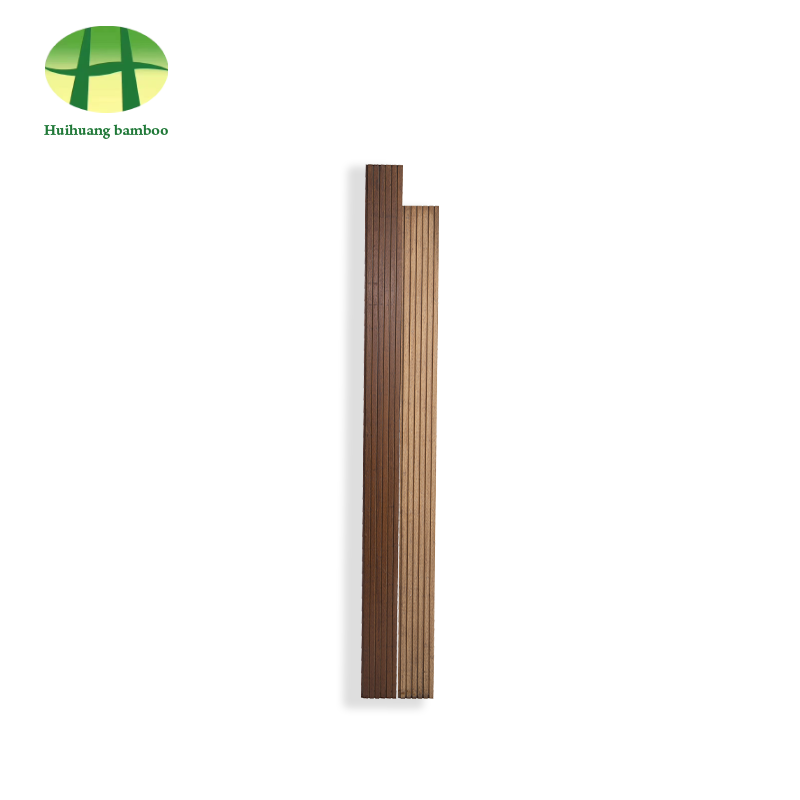
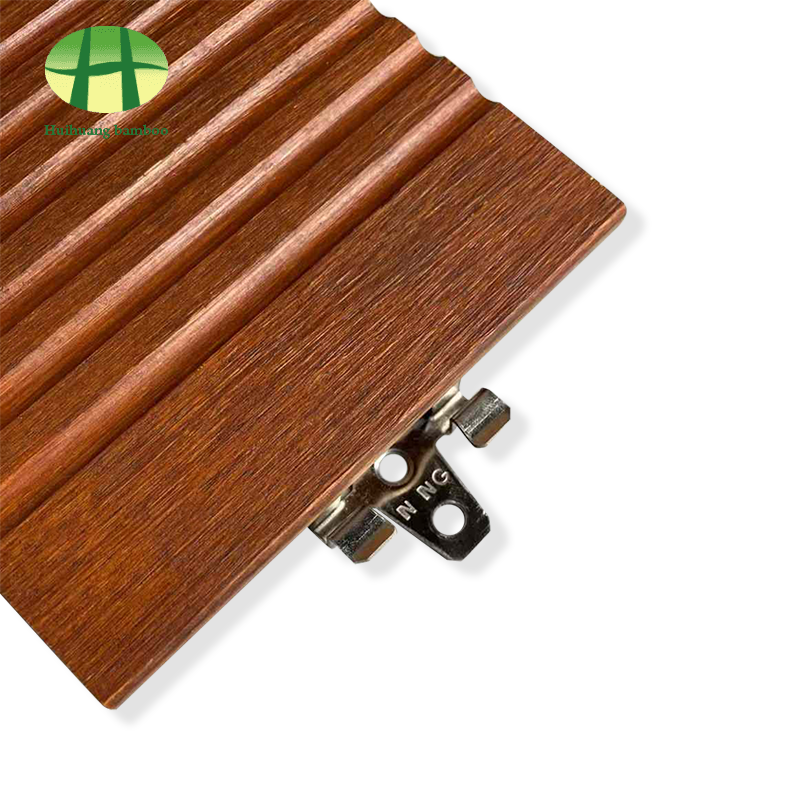 Mechanically Fixed Strand Woven Bamboo Flooring with Hidden FastenersThis fastener-spliced plank suits projects requiring mechanical fixing instead of click profiles. Its hidden-clip installation on a ventilated substructure allows a seamless, neat finish while remaining removable and reusable for temporary spaces.View Product →
Performance Requirements During Service Life
A click floor's service life is defined by the humidity and surface conditions it is kept in; exceeding them is the leading cause of premature failure. The boards handle decades of traffic, but the joints cannot take standing water or a room that swings between 25% and 70% RH.
- Keep the room between 40% and 60% RH; in heating season, run a humidifier whenever the level drops below 40%.
- Wipe wet spills and standing water immediately with a dry microfiber cloth; water wicks into click seams.
- Never use a steam mop or a wet mop; clean with a pH-neutral bamboo floor cleaner and a barely damp cloth.
- Place doormats at entrances and limit direct, prolonged sunlight, which fades any natural flooring finish.
For genuinely wet positions, such as shower-adjacent terraces, exterior steps, or pool surrounds, specify a grooved anti-slip board rather than a click strip; standing water finds every seam in a floating floor.
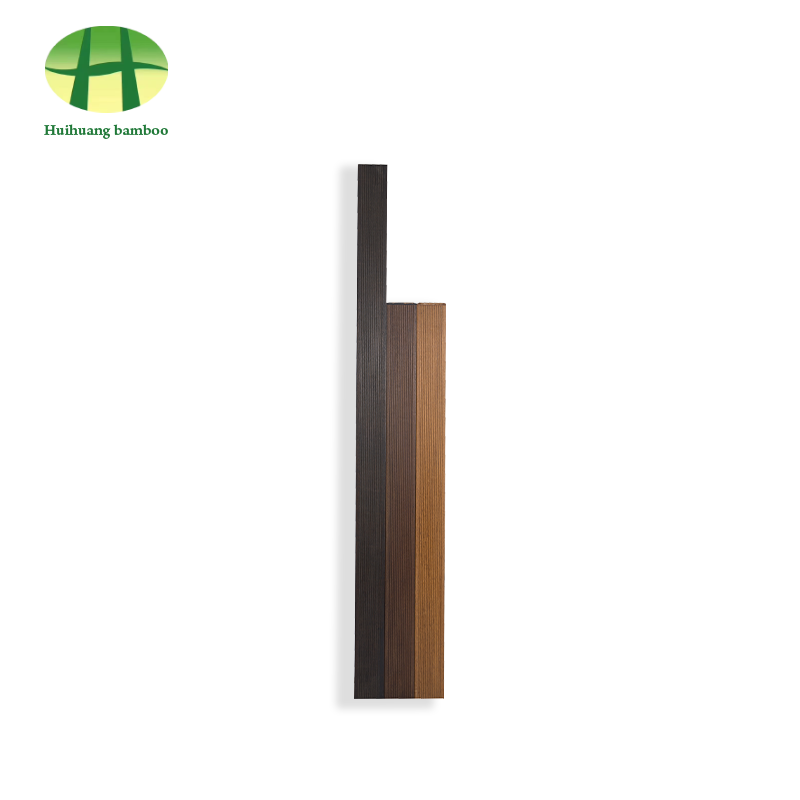
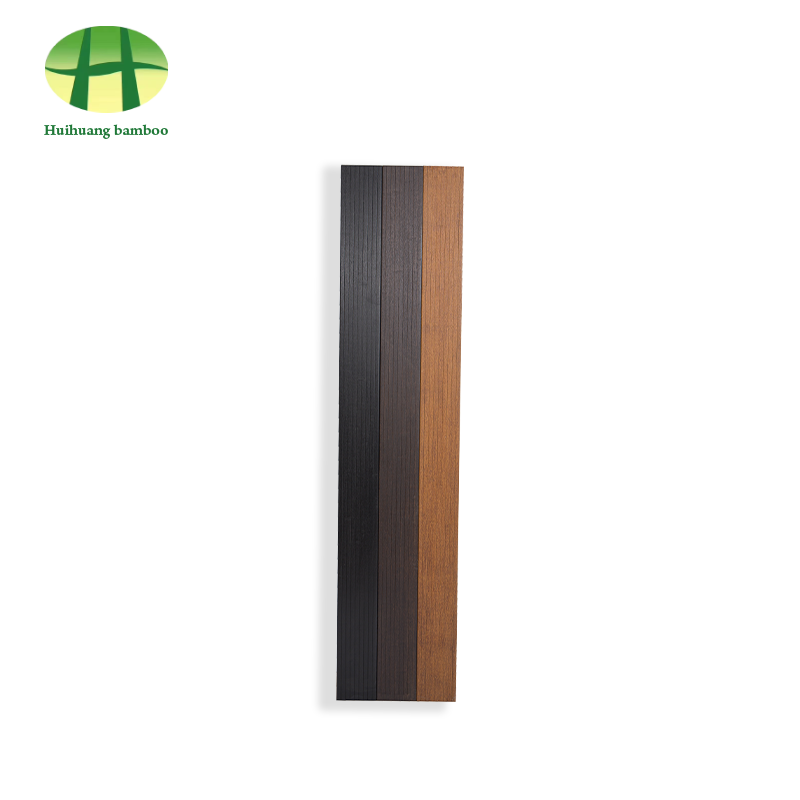 Grooved Anti-Slip Strand Woven Bamboo Flooring for Wet AreasDesigned for genuinely wet positions like shower-adjacent terraces and pool surrounds, this high-density carbonized board features fine groove textures that improve slip resistance while staying easy to clean, making it a practical choice for moisture-exposed surfaces.View Product →
How to Verify Click-Grade Quality Before Purchase
Click-grade strand woven bamboo is made, not discovered: manufacturer process control determines whether profile tolerances hold across entire production batches. A beautiful sample means nothing if the next container arrives with a different groove depth.
Verify four things before committing to a supplier. First, management systems: ISO 9001 and ISO 14001 certification show that quality and environmental processes are documented. Second, material provenance: FSC certification tracks the bamboo fiber source. Third, product technology: Huihuang Bamboo is a licensed manufacturer and exporter under US patent US11148318, which covers outdoor strand woven bamboo decking, evidence that the profile and formulation are engineered rather than copied. Fourth, batch data: request a moisture content report and a written profile tolerance, typically +/-0.1 mm on the click geometry.
- ISO 9001 and ISO 14001 documented quality and environmental systems
- FSC-certified fiber sourcing for tracked raw material
- Licensed US patent US11148318 for outdoor strand woven decking
- Batch MC report with a +/-0.1 mm profile tolerance in writing
Interior projects that want a smooth, uniform surface and standard dimensions to simplify floating installation can use the standard-size glossy strand woven board, milled for consistent geometry across order volumes.
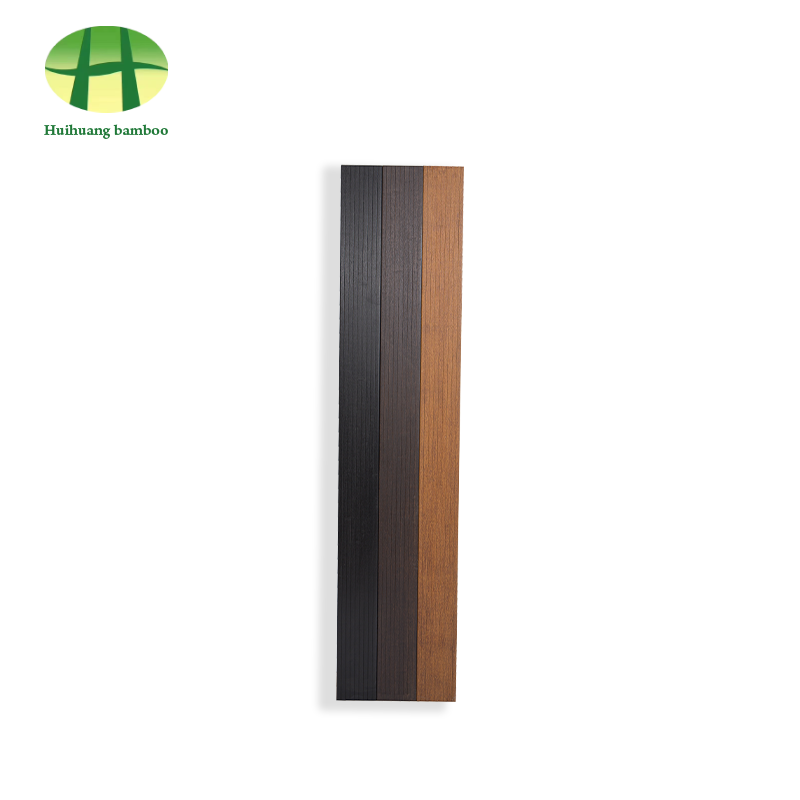
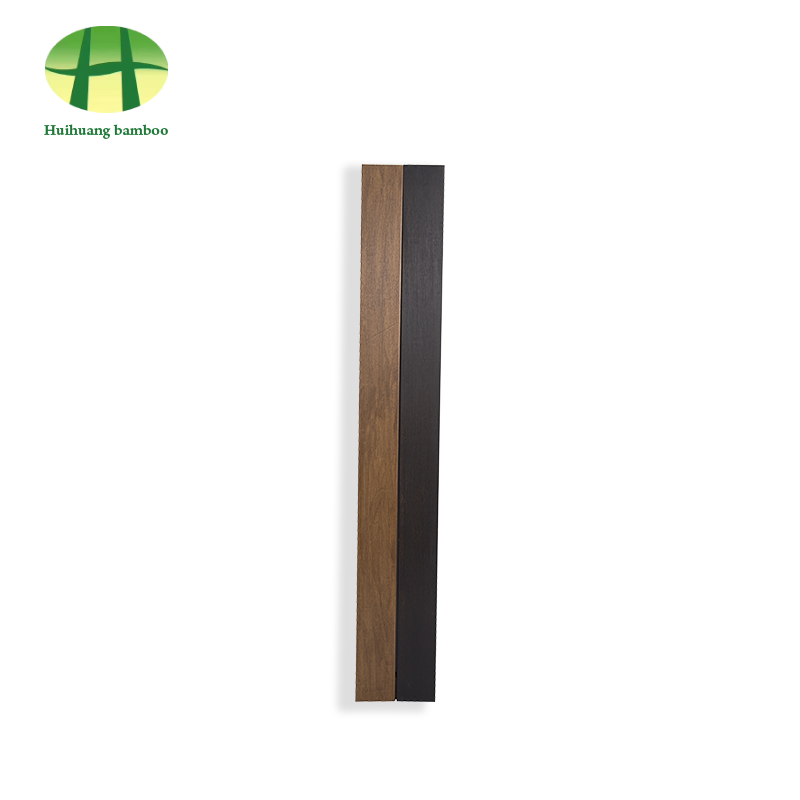 Standard-Size Glossy Strand Woven Bamboo Decking for Large AreasThis board's regular dimensions (e.g., 1860mm×140mm) support straightforward floating installation over large interior or exterior areas. Its consistent milling and glossy finish provide a smooth, uniform surface suited to projects requiring standard sizing.View Product →
Frequently Asked Questions
Can click strand woven bamboo be installed over a concrete slab?
Yes. Install it as a floating floor over a 2-in-1 underlayment with a vapor barrier, but only after the slab measures below 2.5% CM and is flat within 3 mm per 1 m. Skipping the moisture reading risks cupping and joint swelling in the first year.
Are expansion gaps really necessary with click bamboo?
Yes. Leave 10-12 mm around the entire perimeter and around columns and pipes, and fit transition strips at runs over 10 m long or 8 m wide. A floating floor is a single moving sheet; gaps are what let it breathe without buckling.
Is strand woven click flooring waterproof?
No. The boards are water-resistant, but click seams remain the weak point and water migrates through them. For bathrooms, wet rooms, or exterior decks, select a grooved anti-slip strand woven board designed for outdoor exposure instead.
How long does a click strand woven bamboo floor last?
Indoors, with room humidity kept between 40% and 60% and spills wiped promptly, a well-made strand woven click floor serves 20-30 years. The warranty only holds if the installer logs acclimation time and subfloor moisture readings.
 View More

 +86-572-5215066 5216895
 office@hh-bamboo.com
 East Side of Huanggang RD,Ningdun County, Ningguo ,Xuancheng City,Anhui Province,China.
