


 English
 Deutsch
Content
Quick answer: Outdoor bamboo flooring is one of the most durable, sustainable, and hard-wearing decking materials available today — provided it is manufactured as strand-woven bamboo rather than standard horizontal or vertical laminated bamboo. It is made primarily from Moso bamboo (Phyllostachys edulis), processed through a high-pressure strand-weaving method that produces a material harder than most hardwoods, with a Janka hardness rating of 3,000–5,000 lbf. It is used in decks, patios, pool surrounds, walkways, and commercial outdoor spaces worldwide. This guide covers every key question in depth with specific data.
What Bamboo Is Used for Flooring?
Virtually all commercial bamboo flooring — both indoor and outdoor — is made from a single species: Moso bamboo (Phyllostachys edulis). Out of the roughly 1,400 documented bamboo species, Moso accounts for an estimated 70–80% of global bamboo flooring production. Understanding why reveals the material science behind bamboo flooring's performance.
Why Moso Bamboo Dominates Flooring Production
- Rapid maturity: Moso culms (stems) reach full height — up to 20–28 meters — within 60 days of emergence, and achieve the fiber density required for flooring within 4–6 years. Timber hardwoods used in comparable flooring (oak, teak, ipe) require 25–80 years. This growth cycle makes Moso one of the most renewable structural materials on earth.
- High silica and fiber density: Mature Moso culm walls contain a high concentration of vascular bundles — the structural fibers that give bamboo its load-bearing strength. Outer culm sections, which are used in quality flooring, have a fiber density comparable to or exceeding many temperate hardwoods.
- Culm diameter and wall thickness: Moso produces culms with diameters of 8–18 cm and wall thicknesses of 8–15 mm — large enough to yield sufficient material for flooring strip production, unlike smaller bamboo species.
- Geographic concentration: Moso grows predominantly in Zhejiang, Fujian, Hunan, and Jiangxi provinces of China — a concentrated growing region that supports a large-scale, vertically integrated manufacturing industry supplying the global market.
Other Bamboo Species Used in Niche Applications
- Guadua angustifolia (Guadua bamboo): Native to South America, particularly Colombia and Ecuador. Has extremely thick culm walls and high compressive strength. Used in structural construction and some regional flooring production, but not yet available at industrial scale for export flooring markets.
- Dendrocalamus asper (Giant bamboo): Used in Southeast Asian flooring production at smaller scale. Larger culm diameter but lower fiber density than Moso in the outer wall.
- Bambusa vulgaris: Widely distributed but lower-quality for flooring due to thinner walls and lower fiber density. Used in local construction but rarely in commercial flooring exports.
For outdoor and decking applications specifically, the species choice is less critical than the manufacturing method — strand-woven processing transforms even standard Moso into a material with fundamentally superior hardness, density, and moisture resistance compared to any conventionally laminated bamboo flooring product.
How Bamboo Flooring Is Made
The manufacturing process determines whether a bamboo flooring product is suitable for outdoor use. There are three principal manufacturing methods, and they produce materials with dramatically different performance profiles.
Horizontal and Vertical Lamination (Indoor Standard)
These are the original and most widely recognized bamboo flooring formats. Moso culms are split into strips or sliced into flat sections, which are boiled or steam-treated to remove starch and sugars (which would otherwise attract insects and mold), dried to controlled moisture content, and then laminated under heat and pressure using urea-formaldehyde or soy-based adhesive.
- Horizontal lamination: Strips are laid flat, showing the natural nodes and grain across the face. Three layers are glued with grain running in the same direction.
- Vertical lamination: Strips are rotated 90° and edge-glued, presenting a tighter, more linear grain pattern on the face surface.
Both processes produce boards with a density of approximately 0.6–0.7 g/cm³ and a Janka hardness of around 1,200–1,600 lbf — comparable to oak (1,290 lbf) but not suitable for exposed outdoor use due to adhesive susceptibility to moisture ingress and relatively modest surface hardness.
Strand-Woven (Strand-Compressed) Process — The Outdoor Standard
Strand-woven bamboo is categorically different from laminated bamboo. The process:
- Moso culms are mechanically crushed or shredded into coarse fiber strands rather than cut into uniform strips.
- Strands are dried to a precise moisture content of 6–8%, then saturated with phenol-formaldehyde (PF) resin — a waterproof exterior-grade adhesive, the same resin class used in marine-grade plywood. Unlike urea-formaldehyde used in interior laminated bamboo, phenol-formaldehyde is highly resistant to moisture breakdown.
- The resin-impregnated strands are loaded into steel molds and compressed under pressures of 120–200 kg/cm² at temperatures of 140–180°C. This simultaneous heat and pressure cures the resin and fuses the strands into a single homogeneous block.
- The compressed blocks are precision-sawn into decking planks and profiled — typically with a grooved underside for ventilation and anti-slip ribbing or brushed texture on the face surface for outdoor traction.
The result is a material with a density of 1.1–1.3 g/cm³ — nearly twice the density of laminated bamboo and exceeding most tropical hardwoods — and a Janka hardness of 3,000–5,000 lbf.
Carbonization: The Process That Affects Color and Hardness
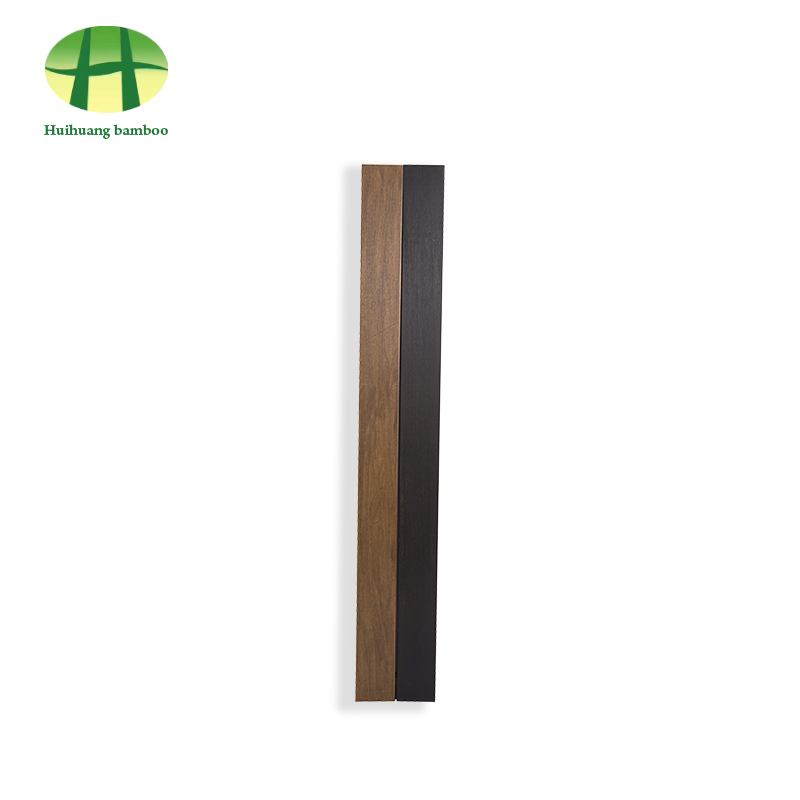
Before lamination or strand-weaving, bamboo strips or fibers are sometimes subjected to carbonization — a controlled steam-heating process at approximately 160–180°C that caramelizes the natural sugars in the bamboo, producing a medium to dark brown color without staining or dyeing. The tradeoff is a modest 10–15% reduction in hardness compared to uncarbonized (natural) bamboo, because the heat treatment slightly degrades the structural fiber. For outdoor use, natural (uncarbonized) strand-woven bamboo delivers maximum hardness and weather resistance.
Manufacturing Method Comparison
| Method | Density (g/cm³) | Janka Hardness (lbf) | Adhesive Type | Outdoor Suitability |
| Horizontal lamination | 0.60–0.68 | 1,200–1,400 | UF or soy-based | Not recommended |
| Vertical lamination | 0.62–0.70 | 1,300–1,600 | UF or soy-based | Not recommended |
| Strand-woven (natural) | 1.10–1.30 | 3,000–5,000 | Phenol-formaldehyde (PF) | Excellent |
| Strand-woven (carbonized) | 1.05–1.20 | 2,500–4,000 | Phenol-formaldehyde (PF) | Good |
Are Bamboo Floors Durable?
Strand-woven bamboo flooring is exceptionally durable — in objective hardness tests, it outperforms the majority of hardwood species used in flooring, including teak, oak, maple, and walnut. Standard laminated bamboo flooring is moderately durable for indoor use but is not a durable outdoor material. The distinction is critical.
Hardness: How Bamboo Compares to Competing Materials
| Material | Janka Hardness (lbf) | Density (g/cm³) | Outdoor Use |
| Strand-woven bamboo (natural) | 3,000–5,000 | 1.10–1.30 | Yes (treated or oiled) |
| Ipe (Brazilian walnut) | 3,510 | 1.02–1.10 | Yes |
| Cumaru (Brazilian teak) | 3,330 | 0.98–1.05 | Yes |
| Teak | 1,070 | 0.63–0.75 | Yes (naturally oily) |
| White oak | 1,360 | 0.68–0.77 | Limited (needs treatment) |
| Red cedar | 350 | 0.32–0.38 | Yes (naturally resistant) |
| Composite decking (WPC) | N/A (not rated) | 0.90–1.20 | Yes |
| Laminated bamboo (horizontal) | 1,200–1,400 | 0.60–0.68 | No |
Durability Factors Beyond Hardness
Hardness measures resistance to surface indentation, but outdoor durability encompasses several other dimensions:
- UV resistance: Like all natural materials, bamboo will silver-grey over time under UV exposure without surface protection. Quality outdoor strand-woven bamboo decking is factory-finished with UV-stabilized oil or coating, which should be renewed every 1–2 years depending on sun exposure to maintain color and prevent surface checking.
- Moisture and dimensional stability: Strand-woven bamboo has lower moisture movement than most hardwoods due to its high density and resin content. Properly installed with adequate expansion gaps (6 mm per 1.2 m of board length is the standard allowance) and with board ends sealed, it maintains dimensional stability through seasonal humidity cycles.
- Biological resistance: Raw bamboo is rich in starch and is susceptible to fungal decay and insect attack. In strand-woven manufacturing, the boiling/steaming pretreatment removes starch, and the phenol-formaldehyde resin impregnation adds a degree of rot resistance. However, outdoor bamboo decking exposed to ground contact or persistent moisture should be treated with a boron-based preservative and must be installed with proper drainage and ventilation beneath the boards.
- Slip resistance: Quality outdoor bamboo decking is profiled with anti-slip ribbing or mechanically brushed to achieve a wet slip resistance rating of R11 or higher (DIN 51130 classification) — suitable for pool surrounds and rain-exposed decks.
Expected Service Life
With correct installation, regular maintenance (oiling every 1–2 years), and adequate drainage, quality strand-woven bamboo decking has a realistic service life of 20–25 years in temperate climates and 15–20 years in tropical or high-UV environments. Leading manufacturers offer product warranties of 10–15 years for outdoor applications — a meaningful benchmark against composite decking (typically 25-year warranties) and pressure-treated pine (10–15 years in ground-contact conditions).
Where Is Bamboo Wood Flooring Used?
Bamboo flooring spans a broad range of indoor and outdoor applications. The appropriate product specification — laminated bamboo for interior, strand-woven for exterior — determines fitness for purpose in each context.
Outdoor and High-Exposure Applications
- Residential decking and terraces: The primary growth market for outdoor strand-woven bamboo. Offers the aesthetic warmth of hardwood decking with superior surface hardness and more sustainable sourcing credentials than tropical hardwoods such as ipe or merbau, which face sourcing restrictions in Europe and Australia.
- Pool surrounds and wet areas: High-density strand-woven boards with anti-slip profiling are specified for pool decks. The material's resistance to chlorine-laden splash water and its non-splintering surface make it preferable to many timber alternatives in this application.
- Commercial boardwalks and public walkways: Municipal projects in the Netherlands, Germany, Australia, and Japan have installed bamboo decking in public boardwalk applications, citing durability, sustainability certification (FSC), and lifecycle cost advantages over tropical hardwoods.
- Roof terraces and balconies: The lightweight density advantage of strand-woven bamboo (approximately 7–9 kg/m² for 20 mm boards) compared to stone or porcelain tile (20–30 kg/m²) makes it a practical choice for elevated structures with load limitations.
- Exterior wall cladding: Vertical strand-woven bamboo panels are increasingly used as rainscreen cladding on commercial and residential facades, taking advantage of the material's hardness, dimensional stability, and low maintenance.
Indoor Applications
- Residential flooring (living rooms, bedrooms, kitchens): Laminated bamboo flooring — both horizontal and vertical grain — is the dominant format for interior residential use. The material's hardness, uniformity, and compatibility with underfloor heating (at board thicknesses of 10–14 mm) make it a competitive alternative to hardwood strip flooring.
- Commercial interiors: High-traffic retail, hospitality, and office spaces specify strand-woven bamboo for interior floors where surface hardness, scratch resistance, and a premium aesthetic are priorities. Hotels in Scandinavia and retail flagships in the UK and USA have used strand-woven bamboo flooring as a sustainability-led specification.
- Kitchens and bathrooms (with precautions): Bamboo flooring is used in kitchens and bathrooms but requires more careful installation detailing than in dry areas — specifically, silicone sealing at all perimeter joints, no board-to-board gapping at room edges, and immediate cleanup of standing water.
- Stair treads: The high Janka hardness of strand-woven bamboo makes it particularly appropriate for stair treads, which receive concentrated impact loading. Solid strand-woven treads at 20–25 mm thickness resist wear at nosings far better than laminated bamboo or standard hardwood veneered products.
Applications Where Bamboo Flooring Is Not Appropriate
- Ground-contact outdoor applications: Direct soil contact creates persistent moisture exposure that exceeds the biological resistance of bamboo regardless of resin content. Use pressure-treated timber or composite materials for ground-contact applications.
- Submerged or continuously saturated conditions: Bamboo flooring is not a marine or submerged material. Persistent water contact will eventually breach any surface coating and cause deterioration.
- Extremely high-humidity interior spaces: Steam rooms, indoor pool enclosures, and commercial laundries create humidity levels that exceed what any wood-based flooring — bamboo included — can tolerate without warping, delaminating, or swelling.
Sustainability: Why Bamboo Flooring Has a Material Advantage
The sustainability case for bamboo flooring is one of its strongest selling points, particularly when compared directly to the tropical hardwoods it replaces in outdoor decking applications.
- Carbon sequestration rate: Moso bamboo sequesters carbon at a rate of approximately 5–12 tonnes of CO₂ per hectare per year — significantly faster than most temperate and tropical forests due to its rapid biomass accumulation rate.
- No replanting required: Bamboo is a grass, not a tree. Harvesting culms does not kill the plant — the root system (rhizome network) regenerates new culms continuously. A bamboo grove harvested on a 5-year rotation cycle continues producing indefinitely without replanting.
- FSC certification: The Forest Stewardship Council certifies Moso bamboo forestry operations under its standard for non-timber forest products. FSC-certified bamboo flooring provides chain-of-custody documentation from forest to finished product — the equivalent assurance to FSC-certified hardwood but from a far faster-renewing source.
- Compared to tropical hardwood decking: Premium tropical decking species such as ipe, cumaru, and merbau are sourced from slow-growth tropical forests with documented deforestation pressure. The EU Timber Regulation (EUTR) and similar legislation in the UK and Australia increasingly restricts the import of tropical hardwood without verified legal and sustainable sourcing documentation — a compliance burden that bamboo, with its plantation-grown supply chain, largely avoids.
 View More

 +86-572-5215066 5216895
 office@hh-bamboo.com
 East Side of Huanggang RD,Ningdun County, Ningguo ,Xuancheng City,Anhui Province,China.